
Update, 27 Aug: The SBA now has paperwork. The website still is not a SAM.gov path. Smaller War Plants Now Has a Website — Still No SAM.gov Path →
On Monday, Defense Secretary Pete Hegseth stood in a hangar at Wittman Regional Airport and told Oshkosh’s factory floor to keep doing its part. On Tuesday, he and SBA Administrator Kelly Loeffler announced a Smaller War Plants Commission — a name lifted directly from 1942. On Wednesday morning, an exact-phrase SAM.gov search for “smaller war plants” returns no matches, and the Federal Register has never printed the commission’s name. The gap between the speech and the paperwork is the story, and it should set a small defense firm’s priorities this week.
Two Days of Wartime-Production Rhetoric
The rhetoric is running hot, and it is not empty theater. The country is six months into the conflict with Iran, munitions stocks are a live concern, and earlier this month Deputy Defense Secretary Steve Feinberg gave industry 21 days to submit plans for significantly faster weapons production. Monday’s stop at Wittman Regional Airport — JLTVs and ROGUE-Fires parked behind the podium — was part of the Pentagon’s “Arsenal of Freedom” tour through American defense plants. Hegseth’s message to the workers: “Keep doing your part right here on the factory floor,” with a promise that the Pentagon would keep cutting red tape.
Tuesday extended the theme from trucks to the whole small-manufacturer base. In a joint announcement posted to X, Hegseth and Loeffler unveiled the Smaller War Plants Commission, a Pentagon–SBA venture billed as the modern successor to the World War II Smaller War Plants Corporation. By the announcement’s own count, small manufacturers make up roughly 70 percent of the defense industrial base. The stated aim is to help them tool up, expand operations, and hire, with SBA’s nearly $500 billion small-business portfolio pointed at the problem. “American battlefield readiness runs through our small businesses, and it always has,” Hegseth said. Loeffler: “America must build what our military needs when it needs it, right here at home.”
Every word of that describes a real gap. None of it, so far, is a mechanism.
What the 1942 Corporation Could Do That a 2026 Commission Cannot
The name being revived belonged to something with teeth, and the teeth are the part the revival has not reproduced. Congress chartered the Smaller War Plants Corporation by statute on June 11, 1942, as a corporation under the War Production Board — a balance sheet with a mission, not an advisory body. It could lend a small plant money for the acquisition, conversion, and operation of plants and facilities. It could buy machinery and surplus property and put it in small firms’ hands. And it carried the sharpest tool ever given to a federal small-business agency: it could take a prime contract from a procurement agency in its own name, then subcontract the work into small shops that would never have won it alone.
That machinery moved real volume. With SWPC’s help, small firms captured roughly 110,000 prime contracts and subcontracts worth about $6 billion in 1940s dollars between 1942 and 1945. When the war ended, the corporation was dissolved — effective January 1946, its lending went to the Reconstruction Finance Corporation and its remaining functions to the Commerce Department — and the model was reborn in peacetime as the Small Business Administration in 1953.
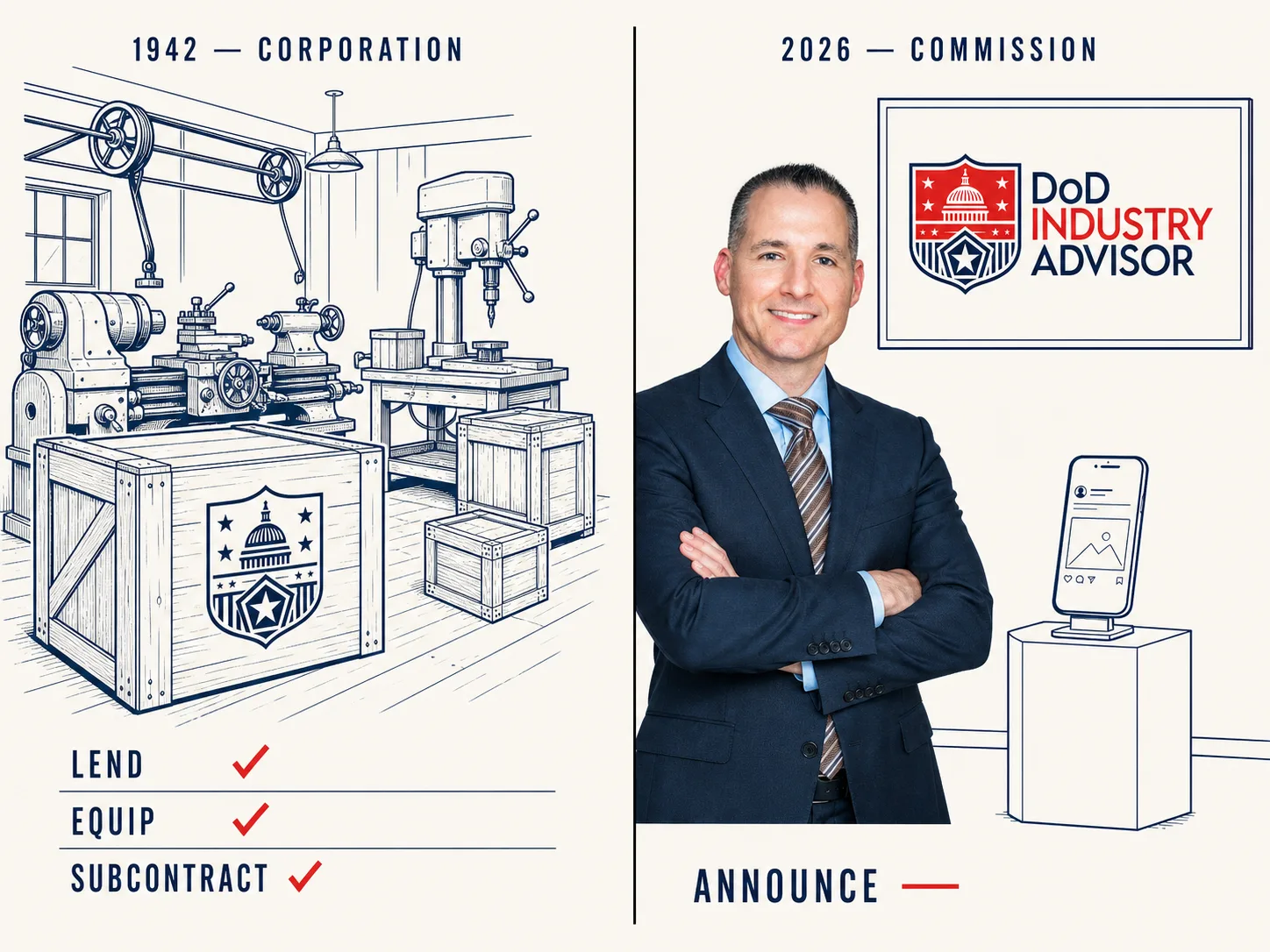
The 1942 corporation could lend, equip, and subcontract in its own name. The 2026 commission, so far, can announce. (DIA editorial illustration.)
The 1942 entity worked because it had statutory authority, appropriated capital, and a signature that could bind the government. A commission announced in a social post has none of those until Congress or an implementing document supplies them. As of this writing there is no charter in the Federal Register, no named office or executive, no funding line, no notice on SAM.gov, and no application window. The firms this week’s speeches will attract — the machine shops, the armor formers, the build-to-print fabricators the word “makers” is aimed at — have nowhere to send anything.
Ceilings Are Not Cash — Monday Proved It
While the podium was busy, the Pentagon’s Monday contract list quietly demonstrated the distinction that should govern how you read all of this. Boeing received the F-15 Eagle Crest contract (FA8634-26-D-B001): an indefinite-delivery/indefinite-quantity vehicle with a $131.23 billion ceiling covering production, modernization, sustainment, and depot standup, with foreign military sales to seven countries. Obligated at award: $343,740 in FY26 research and development funds. That is roughly three millionths of the headline number. The ceiling authorizes orders. Only orders are revenue.
The same list carried the small-business version of the same lesson. Hardwire LLC of Pocomoke City, Maryland — a 130,000-square-foot armor manufacturer, as close to the speech’s ideal “maker” as the industrial base offers — received a $99 million firm-fixed-price IDIQ for advanced processing of metallic armor, producing steel and titanium components for Army combat vehicles. Work locations and funding will be determined with each order. Hardwire already holds a $416 million IDIQ from March 2025 for body-armor plates. The firms that actually match this week’s rhetoric are not waiting for a commission. They hold ceilings, and what converts a ceiling into payroll is a delivery order, not applause.
Even Monday’s host knows the difference. Oshkosh lost the JLTV follow-on contract to an out-of-state competitor in 2023 — a point Wisconsin’s own congressman raised during the visit. A firm can host the speech, build the trucks behind the podium, and still need the order book.
What This Means for Small Defense Firms
Do not park business development on the commission. There is nothing to apply to, and no schedule for when there will be. The tell that it is becoming real will be paperwork, not podiums: a charter or DoD–SBA implementing memorandum, a named executive and office, and money moved by appropriation or transfer. Watch the Federal Register and SBA’s program announcements for those three artifacts. Until they exist, the commission can convene and encourage; it cannot obligate a dollar.
Work the lanes that produced this week’s actual vehicles. Hardwire’s new ceiling did not come from a commission. It came through SBIR Phase III — the sole-source continuation lane reserved for work that grew out of a firm’s earlier SBIR awards. If you have Phase I or II lineage, that is an application window that already exists, with no waiting on Washington to invent one. The same goes for existing IDIQs you hold or can team onto: the near-term money in this market is in delivery orders under ceilings that are already signed.
Read every announcement in obligation terms. Ceiling equals permission; obligation equals cash. For each headline, ask what was obligated, on which vehicle, by which office. In years around the Pentagon and Capitol Hill, the reliable tell was never the podium — language becomes money through a charter, a line item, and a contracting officer’s signature. That test takes thirty seconds and would have correctly sized both of Monday’s announcements and Tuesday’s.
When the commission does acquire authority, expect it to route through plumbing that already exists — SBA’s lending programs and the Pentagon’s small-business and SBIR infrastructure — the same way SWPC’s own functions were folded into successor agencies after 1946. Firms already positioned in those lanes will be first through whatever door eventually opens.
The Signal
Treat the Smaller War Plants Commission as a signal of demand, not a source of it. This week: pull your SBIR lineage and scope a Phase III case, list the ceilings you hold or can team under and work the delivery-order pipeline, and set a simple tracker for the commission’s first real artifact — a charter, an office, an obligation. The firms that win the next twelve months will be converting existing ceilings into orders while their competitors draft applications to a body that cannot yet receive one.
DIA reads announcements in obligation terms so small firms spend business-development hours where money actually moves. Follow for the next signal — and reach out when you want this week’s positioning turned into a capture plan.
DoD Industry Advisor
DoD Industry Advisor helps small defense teams turn policy, budget, compliance, and market signals into earlier capture decisions. Mike Komorous brings defense policy, acquisition, contracting, aviation, and hands-on AI/on-premises machine-learning experience to that work.
Source presentation is carried in the article body where applicable. Reported facts and analytic judgment are kept distinct.