
Three things in Washington’s orbit ran on three different clocks this week: the World Cup on a public schedule, the Iran war ended by a 14-point memo, and the Reflecting Pool turned green. For small defense contractors, the FY27 NDAA (~$1.14T) and the $1.072T Defense bill are moving fast — with a CMMC Level 2 grant and $836M for new-entrant munitions opening the door. The lesson: the render is not the water.
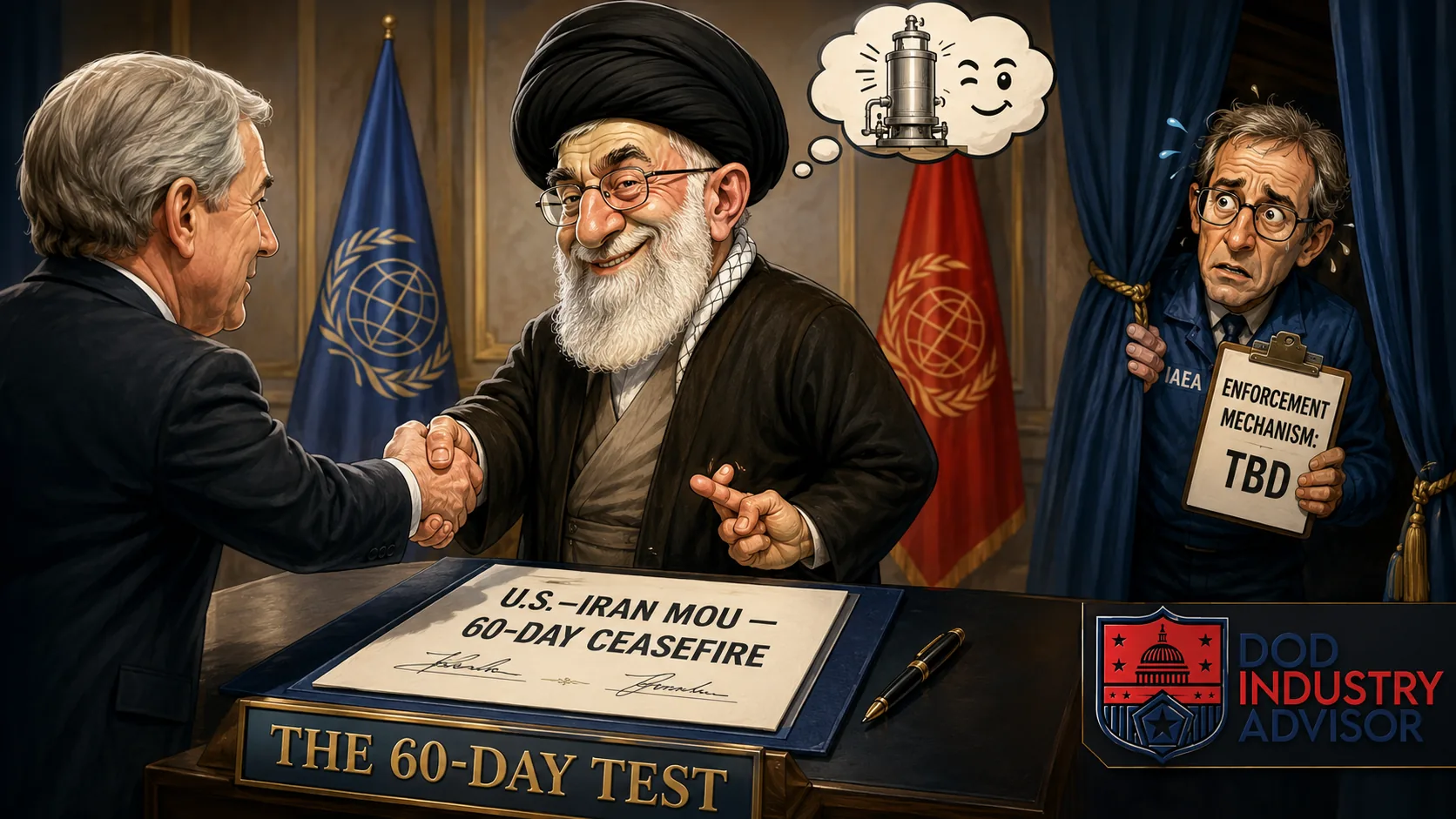
Three things ran on three different clocks in Washington's orbit this week. The World Cup ran on a published schedule — fixtures posted, referees miked, every disputed goal sent to replay. The Iran war ended on the executive's clock — a 14-point memorandum signed Wednesday, no treaty, no ratification vote, the Senate finding out the way the rest of us did. And the Lincoln Memorial Reflecting Pool ran on a deadline clock — painted “American flag blue” for the country's 250th birthday and turning green by the weekend. For a small defense contractor, the through-line is the gap between what's on the render and what's in the water. The money moving through the FY27 NDAA and the Defense bill is the largest in the history of the line item, and it's moving fast. Fast is good when the schedule is public and the spec holds. Fast is how you end up with a $14.6 million paint job blooming algae when the process underneath gets skipped.
A World Cup is the most honest thing in sports because the schedule is public and the replay is binding. Everyone sees the fixture. Everyone sees the booth re-draw the offside line. When the United States beat Australia 2–0 in Seattle on Thursday to reach the knockout rounds — the first back-to-back World Cup wins for the U.S. men since 1930 — nobody had to take anyone's word for it. The tournament the country is hosting for its 250th summer runs on a clock you can read from the cheap seats.
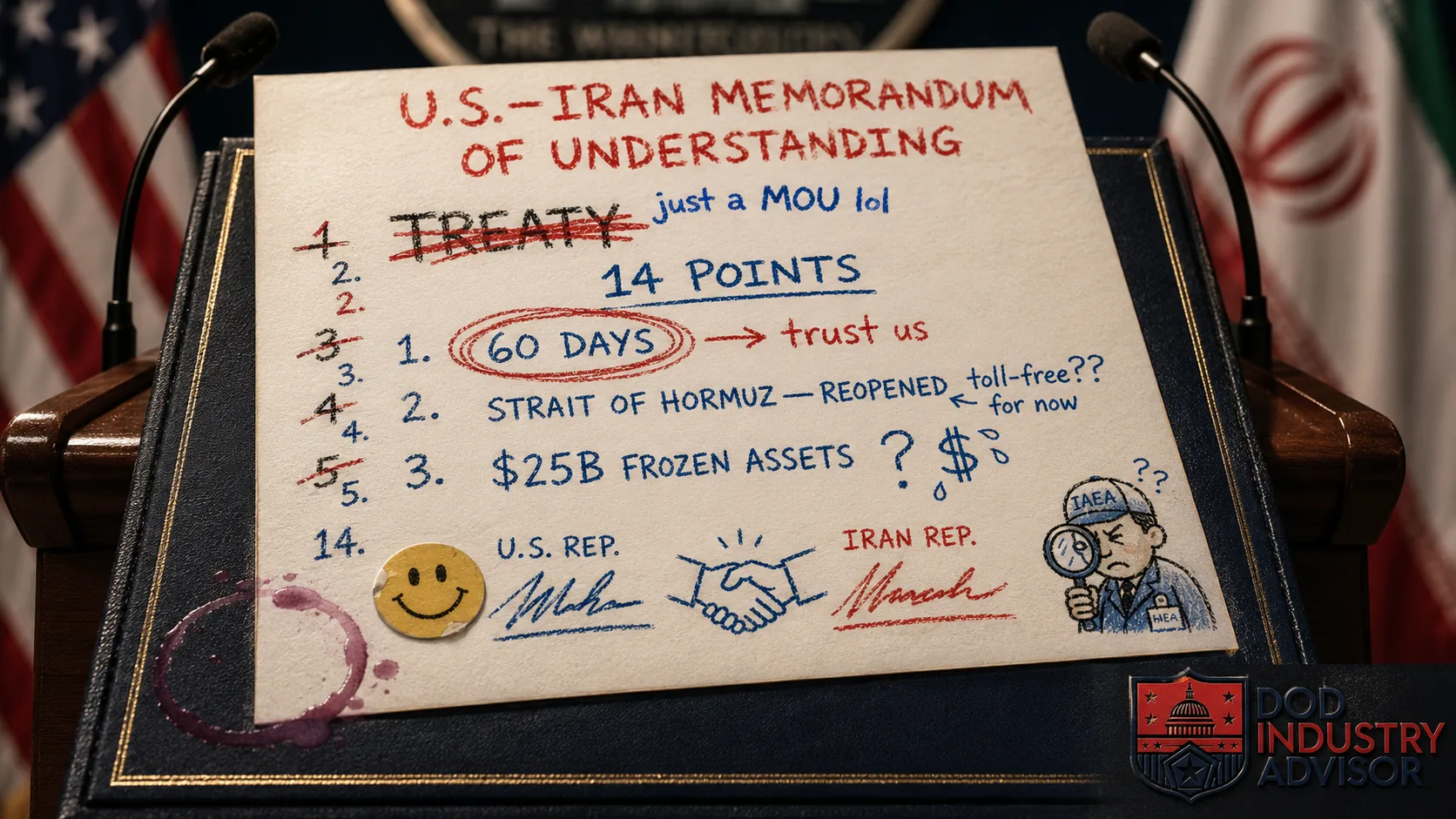
Two of this week's three big stories did not run that way. On June 17, President Trump and Iranian President Pezeshkian signed a 14-point Memorandum of Understanding — Pakistan's prime minister mediating and co-signing — ending the war that began with unauthorized U.S. and Israeli strikes back in February. It re-drew the most consequential line on the board, the line between war and not-war, without sending the play upstairs to the body the Constitution put in the booth. Note the noun: memorandum, not treaty. No Senate ratification. A 60-day ceasefire, the Strait of Hormuz reopened toll-free, the naval blockade lifted, and up to $25 billion in frozen Iranian assets dangled against future compliance.
And the Reflecting Pool got its own offside call from biology. The administration spent a reported $14.6 million on a no-bid contract to paint the pool bottom “American flag blue” for the 250th, and within weeks the most photographed water in America was the color of a forgotten aquarium. Pool specialists have a name for it: “New Pond Syndrome.” Here is the frame for the week, and it is the one your capture team should keep taped to the wall: the render is not the water. The press-release topline, the “largest in history” number, the ribbon-cutting before the deadline — those are the render. What's actually in the pool is the process: did the competition happen, did the spec hold, did the small business get a real lane or a painted-on one.
The Group-Stage Table
Everything moved fast this week. Only one of these ran on a clock everyone could see.
| Side | Status | Result |
|---|---|---|
| FY27 NDAA | Senate Armed Services advanced its ~$1.14T bill 18–9 at the June 11 markup; the committee report posted June 18, putting the attritable-munitions and small-business language on the record | ▲ Out of committee |
| FY27 Defense Approps | House Defense Subcommittee marked up a $1.072T bill; $836M for new-entrant low-cost munitions with multiyear authority, $2.9B for DPA/OSC/IBAS; full-committee markup June 24 | ▲ Moving |
| U.S.–Iran War | Ended by a 14-point MOU signed June 17 (not a treaty): 60-day ceasefire, Hormuz reopened, blockade lifted, $25B in assets in play — after the House's June 3 War Powers vote (215–208) was overtaken | — 60-day clock |
| Small-Business Access | The NDAA establishes a grant program to cover CMMC Level 2 certification costs for small and nontraditional contractors; SBA has not yet posted the FY25 scorecard | ▲ Door opening |
| The Reflecting Pool | A ~$14.6M no-bid “American flag blue” repaint bloomed green within weeks; paint peeling, NPS deploying pool vacuums and ozone nanobubbles | ▼ Gone green |

The War Ended By Memo, Not By Congress
Strip away the diplomacy and the Iran MOU is a lesson in which clock runs the money. The war that began in February with strikes launched without congressional authorization ended on June 17 with a document the Senate never voted on. The House had actually passed its War Powers resolution 215–208 on June 3 — four Republicans crossing over — and got exactly the constitutional answer it has gotten since 1973: noted, and overtaken by events. A 60-day framework is not a treaty; it is a clock. If it holds, sanctions-relief and reconstruction questions open downstream. If it breaks at day 61, the munitions demand signal gets louder, not quieter.
A 60-day framework is not a treaty. It is a clock — and the work it creates is all on the supply side, which is being funded right now.
That is the part a defense reader should circle. A four-month shooting war — strikes, a naval blockade, Hormuz closed — burns through munitions, and both the NDAA (a new War Reserve Stockpile program, accelerated attritable munitions) and the Defense bill ($836 million for new-entrant munition systems with multiyear authority) are Congress writing the reorder slip. Multiyear authority is the part that changes your math: it converts a one-year hope into a fundable, multi-year demand signal you can take to a lender or a teaming partner. The memo on the podium runs on a 60-day clock; the supply chain it implies runs for years.
The Real News For Small Business Is A Certification Grant
Buried in the Senate Armed Services Committee’s FY27 NDAA report — the one that posted June 18, which is when the fine print becomes real — is the most concrete small-business provision in years: a grant program to help small businesses and nontraditional contractors cover the cost of CMMC Level 2 certification. Certification cost has been the quiet tollbooth keeping small and nontraditional firms off the controlled-data work. If that language survives conference, the toll gets subsidized — which means your CMMC readiness stops being a sunk cost and starts being a near-term competitive position.
Pair that with the appropriations side and the intent is unmistakable. The House FY27 Defense bill runs $1.072 trillion in discretionary money, and the industrial-base lines are unusually specific: $836 million to procure new-entrant low-cost munition systems with multiyear authority for the first time, more than $7.5 billion for hypersonics and test infrastructure, and more than $2.9 billion across the Defense Production Act, the Office of Strategic Capital, and Industrial Base Analysis and Sustainment. This is the most explicit “we want new suppliers” money the defense committees have written in a long time. The firms already in motion on Level 2 when the grant lands are the ones who capture the lane; the firms that wait for the check are a year behind.
Pick your single lane in the FY27 Defense bill — munitions, unmanned, hypersonics, or the industrial-base/OSC money — and get one specific, sourced sentence into your capture narrative before the June 24 full-committee markup, so your pipeline language matches the bill language and not last year's. If you are anywhere near controlled-data work, start your CMMC Level 2 path now; do not wait for the grant to clear conference to begin.
The Render Is Not The Water
You can paint the bottom of the Reflecting Pool “American flag blue,” but warm, shallow, nutrient-rich water does what it does, and within weeks the most photographed pool in America was the color of a forgotten aquarium. A no-bid contract, reported around $14.6 million, met the one thing no contract can override: the spec of the natural world. The National Park Service is now out there with pool vacuums, hydrogen peroxide, and ozone nanobubbles, and the new paint is already peeling. It is funny until you realize it is also a procurement parable.
When everything is “largest in history” and racing to a 250th-birthday-and-markup calendar, sole-source and no-bid shortcuts proliferate — that is how a multimillion-dollar pool gets painted without a competition. Fast money flows first to whoever is already in the pool. For a small firm, the defense is to argue the part of this week that is real and citable: the new-entrant intent written into the FY27 text. One thing to stop doing — stop quoting a FY25 small-business “decline” number. The SBA has not posted the FY25 scorecard, the figures floating around are unverified, and the FY24 scorecard actually set a record at about $183.5 billion to small firms. Argue the bill language, not a scoreboard that isn’t out yet.

What This Means for You
• Munitions and unmanned shops: the reorder slip is multi-year. The $836M new-entrant munitions line carries multiyear procurement authority, and the NDAA’s War Reserve Stockpile program is a durable demand signal — the Iran war just demonstrated how fast inventories draw down. Build the capacity story now.
• Anyone near controlled data: start CMMC Level 2 today. The NDAA’s certification-cost grant is the door. Being mid-certification when it lands is worth more than waiting for the money — readiness is the lane, the grant just lowers the toll.
• Watch June 24, not just June 17. The full-committee Defense markup is the next live gate. Match your capture language to the FY27 text before it moves, while the language is still being written.
• Trust the bill, not the topline. “Largest in history” is the render. The water is whether the competition happened. Quote the new-entrant intent in the FY27 text — not a FY25 scorecard that hasn’t been posted.
The Reader’s Box
If the FY27 Defense bill is funding new-entrant munitions and the NDAA wants to pay for your CMMC Level 2, what is the one thing still keeping your firm out of the controlled-data work you are qualified to do — cost, clearance, teaming, or just not knowing the door opened? Reply and tell us. That answer is exactly the conversation to have before the June 24 markup.
Source presentation is carried in the article body where applicable. Reported facts and analytic judgment are kept distinct.