
Lambeau lost a home opener, an Iran war-powers resolution failed in the Senate by one vote, and the House had already gone home. Fiscal year 2027 starts Thursday under P.L. 119-103, and Sections 102 and 104 are still the rules through December 11.

Two things ended this week. Thursday night at Lambeau Field, the Packers lost a home opener for the first time since 2012 — Atlanta 35, Green Bay 14. And the House, which last week’s edition described as having nine session days left, turned out to have none. It cast its last votes on September 16 and does not vote again until November 9.
One thing did not end. Fiscal year 2027 begins Thursday, and it begins under Public Law 119-103, which funds the government at FY26 rates through December 11. Sections 102 and 104 still bar new starts, new production and rate increases on that money. A new fiscal year is a date. It is not an appropriation.
The fiscal year turns over Thursday. The rules do not — but the money on your contract does, and that is the part most small firms never check.
Green Bay had won 13 straight home openers. It is the kind of number that goes on the broadcast graphic before kickoff, and on Thursday it described history, not the game. Bijan Robinson ran 29 times for 194 yards and two touchdowns, Drake London caught nine passes for another 194, and the streak became a footnote with an end date.
A streak is a record of what happened before. A schedule is a record of what was planned. Neither one is the score.
This newsletter learned that one the hard way. Last Sunday’s issue built its argument on the House calendar: nine session days, September 22 through October 2. There were never nine — the published calendar had eight — and House leadership had cancelled the September 21 and September 28 weeks on September 3. On September 16 it cancelled the rest and sent members home to campaign. The record that would have shown it, the Clerk’s roll-call log, has been silent since that afternoon. It was the one source the issue did not check.
The argument survives: the freeze was real, and it still is. The runway did not exist. So this week starts with the correction, and with the rule it teaches. Read the record, not the schedule.
Sources: NFL.com · Bloomberg Government · CBS News · House Clerk
Congressional Calendar — The House Left. The Senate Has One Week.
The two chambers are on different clocks. The House has held only pro forma sessions since September 16 — brief openings with no business and no votes — and its next votes are set for November 9. The early exit also parked Rep. Thomas Massie’s eight articles of impeachment against Secretary Pete Hegseth, filed over the Iran war; Speaker Mike Johnson has said they will be tabled.
The Senate stayed. It met September 22 through 24, returns Monday at 3 p.m. with a 5:30 p.m. vote on passage of S. 4668, a college-sports bill, and is scheduled to remain through October 2. Then it breaks for a state work period from October 5 to November 6.
On Thursday the Senate also took the Iran war-powers vote that last week’s issue left hanging — though not on the resolution the House passed September 15. It voted on H. Con. Res. 89, the resolution the House passed in July, and rejected it 49–50. Four Republicans voted yes; one Democrat voted no. H. Con. Res. 93 sits with the Foreign Relations Committee. Either way, a concurrent resolution never reaches the President, and none of it moves a dollar.
The number for your capture board is not nine, and it is not five. It is zero House votes before the election, and about a month of lame-duck session before the continuing resolution runs out on December 11.
| Sun | Mon | Tue | Wed | Thu | Fri | Sat |
|---|---|---|---|---|---|---|
| Sep 13 | 14Both | 15Both | 16Both · last House votes | 17Senate | 18pro forma | 19 |
| 20 | 21Yom Kippur | 22Senate | 23Senate | 24Senate · H.Con.Res.89 fails | 25 | 26 |
| 27today | 28Senate, sched. · 5:30 vote | 29Senate, sched. | 30Senate, sched. · FY26 ends | Oct 1Senate, sched. · FY27 | 2Senate, sched. | 3 |
| 4 | 5Senate out to Nov 6 | 6 | 7 | 8 | 9 | 10 |
| Nov 1 | 2 | 3Election Day | 4 | 5 | 6 | 7 |
| 8 | 9House votes resume | 10 | 11 | 12 | 13 | 14 |
Dark = both chambers. Outlined = one chamber only. Blank = out; “pro forma” = opened with no business. Past days from the House Clerk and Senate floor records; future days are schedules, marked “sched.” until they happen — the lesson of last week.
The Standings — What Belongs on the Board
The middle column is what the record shows. The last column is the next thing you can actually observe.
| Item | What the record establishes | What to watch next |
|---|---|---|
| Fiscal year 2027 | Begins October 1 under P.L. 119-103, at FY26 rates, through December 11 (Sec. 106(3)). | Full-year bills or a second continuing resolution in the lame duck |
| Sections 102 and 104 | Unchanged. No new production, no rate increases above FY26, no new P-1 or R-1 lines, no new starts on CR money. | Any anomaly that names your specific program |
| House | Last recorded votes September 16; pro forma sessions only since. Votes resume November 9. | The first roll call after the election |
| Senate | Met September 22–24; returns September 28; scheduled through October 2, then out October 5 to November 6. | Whether anything defense-related gets floor time in the last week |
| Iran war powers | Senate rejected H. Con. Res. 89, 49–50, on September 24. H. Con. Res. 93 referred to Foreign Relations. | Nothing that moves money — concurrent resolutions never reach the President |
| FY27 NDAA | H.R. 8800 passed the House 216–212 on July 22; Senate cloture on S. 4784 failed 50–46 on July 14. No conference. | A lame-duck conference |
| DIU CLASS ACT | Two solicitations posted; both close October 13. | Whether you clear the eligibility floor before you write a word |
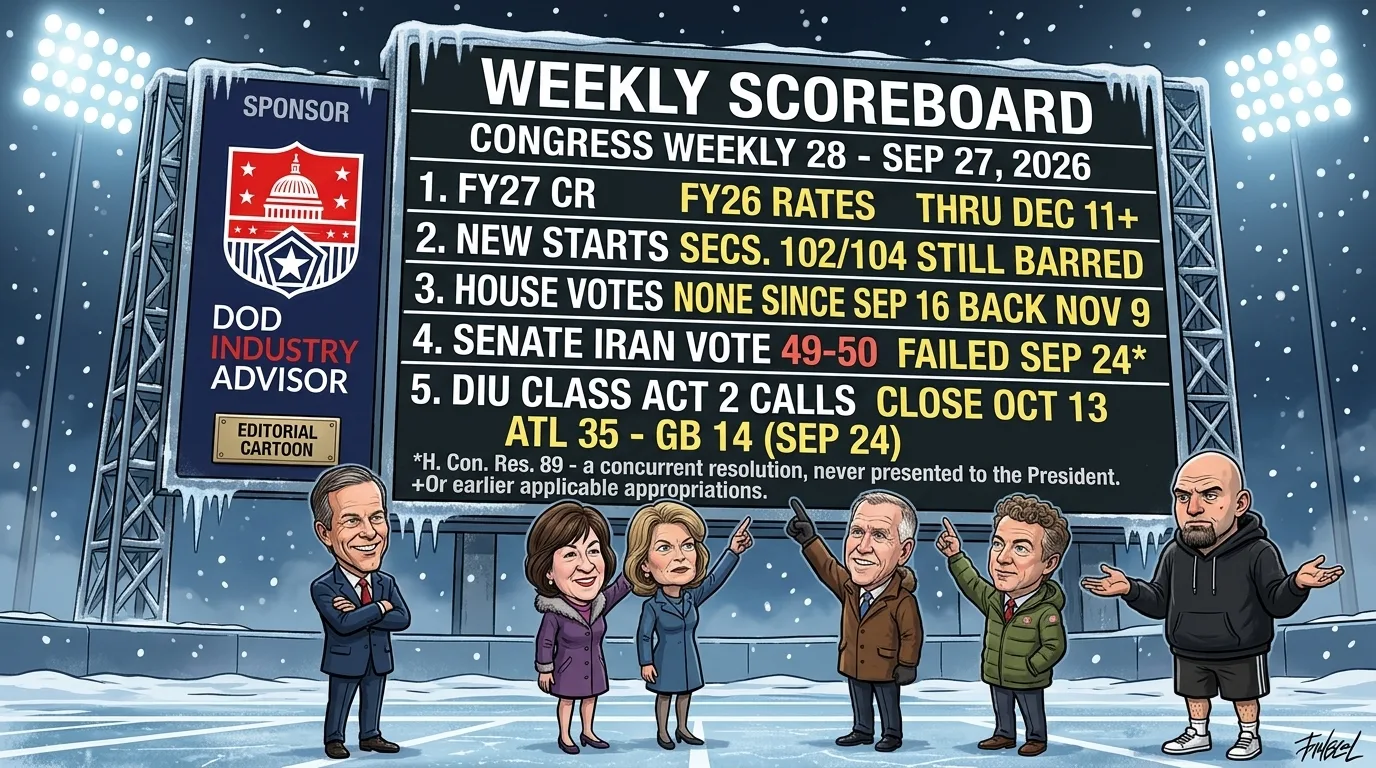

October 1 Is a Date, Not an Appropriation
Expect Thursday’s coverage to read like a season opener: the new fiscal year begins, the funding fight resumes, programs get their shot. Some of that is harmless. The part that is not is the suggestion that October opens a window September kept shut.
It does not. Under P.L. 119-103, Section 101 provides fiscal 2027 money for activities that were funded in FY26, at FY26 rates and under FY26 conditions. Section 102(a) bars the Department from using it for new production of items not funded in FY26 or earlier, for production-rate increases above FY26, or to start projects, P-1 lines or R-1 lines that lacked FY26 authority. Section 104 applies the same no-new-starts rule government-wide. The act says all of that about fiscal year 2027. Thursday is the day it starts applying, not the day it stops.
If your October plan depends on something that did not exist in FY26, the calendar turning over does not help you. Only a law does.
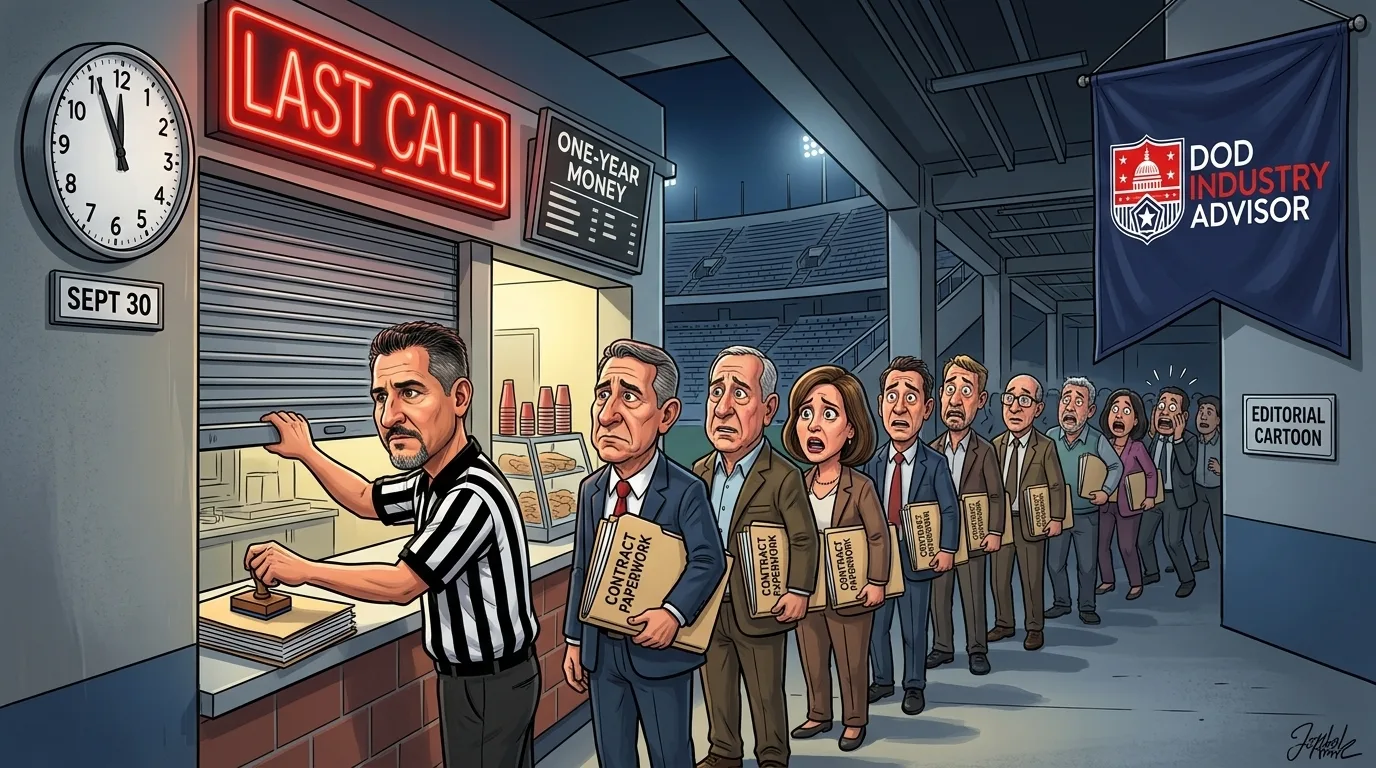
What Thursday does change is quieter and more useful: the age of the money. One-year FY26 money stops being available for new obligations at midnight Wednesday. That is why contracting offices have been busy all month, and why a modification you were promised “before the end of the fiscal year” either arrives by Wednesday or waits on a different pot of money. The Playbook below walks through what that means on your side of the contract.
After the Election — What December 11 Actually Leaves
Here is the fall as the record now shows it. The Senate has one scheduled week left and opens it on college sports. The House is gone until November 9. When both chambers are back, they will have about a month before P.L. 119-103 expires to pass full-year appropriations, pass another continuing resolution, or let funding lapse.
The defense authorization is on the same clock. The House passed H.R. 8800 in July; the Senate’s version stalled on a failed cloture vote the same month, and the bill is widely expected to slip into the lame duck. That is not unusual. The last two election-year NDAAs were both signed on December 23 — the FY2023 act in 2022 and the FY2025 act in 2024.
None of this predicts that nothing happens in December. It is a reason to build October and November on what is enacted — a continuing resolution with bars in it — and to treat anything beyond that as an upside case with a date you cannot yet name.
Weekly Digest — The Bridge Posted. Read the Eligibility Line First.
The DIU facility-clearance story from the last two issues has a solicitation now. DIU posted two CLASS ACT calls: one for companies with sensors and effectors that counter unmanned systems in maritime environments, and one for investors backing such companies. Both close October 13. Awards are prototype other transactions with a possible production follow-on. Defense Daily and Inside Defense tie the calls to DIU’s Bridge clearance effort; the postings themselves do not describe clearance sponsorship, so read them for what they state.
What they state first is an eligibility floor. The vendor call is for nontraditional defense contractors that have never held a facility clearance, with U.S.-citizen key management — and it asks for technology at TRL 7 or higher, at least $10 million in equity raised and at least $2 million in revenue. The investor call asks for at least $100 million in capital. This is a path for venture-backed firms near production, not an open door for every small business that has struggled to get cleared. If you are below the floor, the useful move is to note where the floor sits and what it says about how DIU intends to use the program.
A second item from the same week makes the ceiling-versus-cash point from a new angle. On September 24 the Department announced a $199.7 million requirements contract to GE Aviation’s Dowty Propellers for R-391 propeller assemblies and spares, with “no funds … being obligated at the time of award.” The same day, Northrop Grumman received a not-to-exceed $123.8 million award for APG-85 radar Lot 7 long-lead materials, with FY26 procurement money for the full amount obligated at award. Two nine-figure headlines. One is a place orders can go. The other is money.
Small Business Playbook — October 1 Changes the Money, Not the Rules
Most small contractors track their contract value. Fewer track which fiscal year’s money is on the contract, or how much of it is actually there. This week is the one week a year when that difference moves. Three ideas.
1. Every appropriation has a shelf life. Congress sets a period of availability for each account. For the Defense Department it is typically one year for operation and maintenance and military personnel, two years for research and development, three years for most procurement, and five years for shipbuilding and military construction. Inside that window, the bona fide needs rule requires the money to serve a need of the period it was provided for. That rule is the engine behind the September rush: one-year money not obligated by September 30 cannot go on a new contract action afterward. One study of federal contracting found spending in the last week of the fiscal year running 4.9 times the average of the rest of the year’s weeks.
2. Expired is not the same as gone — until it is. When the period ends, the account expires: no new obligations, but it can still pay invoices and adjustments on obligations properly made while it was current (31 U.S.C. §1553). Five fiscal years later, on September 30, it closes, and whatever is left is cancelled (§1552). This Wednesday is one of those dates: FY2021 operation and maintenance, FY2020 research and development, FY2019 procurement and FY2017 shipbuilding and military construction accounts all close. If you have unbilled work on those funding lines, invoice now; after closure, payment has to come out of current money, within limits. For services, one exception is worth knowing: the Department may fund a severable service contract of up to twelve months that crosses into the next fiscal year with the current year’s money (10 U.S.C. §3133).
3. Your funded amount is the number that matters. Many cost-type contracts are funded in increments, and the Limitation of Funds clause governs them. It requires you to notify the contracting officer in writing when you expect your costs over the next 60 days, added to what you have already incurred, to exceed 75 percent of the amount allotted. The government is not obligated to pay beyond the allotment, and you are not obligated to keep working past it. Consider a hypothetical twelve-person engineering firm on a cost-reimbursement task order with a $4 million value and $1.1 million allotted, spending about $180,000 a month. It owes that notice once incurred costs plus the next 60 days of spending — about $360,000 — pass $825,000, which on that burn rate is about two and a half months in — with the money itself gone around month six. Under a continuing resolution the next increment may come later or smaller than planned. The notice is what protects the firm. Skipping it is how a small company ends up working for free. Read the version of the clause in your own contract; that is the one that binds you.
Pull the latest modification on each contract you hold. For each, write down three things: the fiscal year and type of money on it, the amount allotted (not the contract value), and the date your spending will reach the Limitation of Funds notice point. If any of those dates falls before mid-December, draft the notice now. Then check whether any unbilled work sits on a funding line that closes Wednesday.
The Briefcase — One Page for October 1
The next five weeks will not give you much news to react to. That makes this the week to put the fiscal year on paper.
| Question | What belongs in the answer |
|---|---|
| What money is on each contract? | Fiscal year, appropriation type and allotted amount, from the latest modification — not the award announcement |
| When do we owe a funds notice? | A date for each incrementally funded contract, and the name of the person who sends it |
| Does October need a new start? | One sentence naming any Section 102 or 104 exposure, confirmed with the contracting officer |
| What can wait for December? | Anything that depends on full-year bills or an enacted NDAA, with no date attached until one exists |
If you are already on contract, keep performing, and check your allotment before you check the news. A continuing resolution is not a stop-work order, and neither is a recess.
If you were promised a modification “before the end of the fiscal year,” ask this week whether it will be signed by Wednesday, and if not, what money it will carry when it is.
If you are waiting on a first award, a first production lot or a rate increase, the calendar has not moved in your favor. Plan against December at the earliest, and against a second continuing resolution as a live possibility.
When did you last check the funded amount on your largest contract?
A) This week — I know my notice date
B) This quarter, roughly
C) At award, and not since
D) I know the contract value, not the funded amount
E) Our contracts are fully funded, so it does not apply
Reply with your letter and one thing the fiscal-year turnover is holding up for you. The most useful answer runs next week, anonymous if you prefer.
The Final Whistle
A thirteen-year streak ended in one night at Lambeau. A nine-day runway turned out to be zero. Both were printed before anyone checked the record.
The continuing resolution was checked, and it has not moved. The fiscal year turns over Thursday. The rules turn over only when Congress writes new ones, and the House is not in the building.
How I Help Small Defense Businesses
You may be the owner, the business-development lead and the person checking payroll — all before lunch. The challenge is deciding which opportunity deserves the time your team actually has, especially in a stretch when Washington is quiet and the headlines about a “new fiscal year” suggest more movement than there is.
Through DoD Industry Advisor, I help small defense businesses turn market information into a pursuit decision: examining the buyer, the funding signals, the incumbent and the timing; identifying the gaps in your position; and building a practical plan for what to do next. I also help with proposal and briefing materials when the pursuit calls for them. Explore DIA’s services.
Bring one opportunity you are weighing and the decision you need to make. We can scope the work around whether to pursue it, what needs more evidence, and where your effort belongs over the next 90 days.
Request a 30-minute fit call with DoD Industry Advisor. Start with a non-sensitive summary of your business, the opportunity and your deadline. We will determine fit and define a written scope before work begins.
House calendar. Issue #27 said the House had nine session days from September 22 to October 2. The published calendar listed eight; leadership had cancelled the September 21 and September 28 weeks on September 3; and the House cast its last votes September 16. It had no session days left.
H.R. 6500. The House’s vote on the bill that became P.L. 119-103 was September 1, two weeks before H. Con. Res. 93, not three. The House had returned August 31; September 14 was the Senate’s first week back, not Congress’s.
Senate, September 21. The Senate did not meet that day (Yom Kippur).
Seahawks. Drew Lock’s September 20 start against Arizona was his first of the season, not a continuing one; Sam Darnold was hurt in Week 1.
Sources checked
CONFIRMED
- P.L. 119-103 (H.R. 6500): Signed Sep. 2, 2026. Sec. 101 FY26-rate continuation for FY27; Sec. 102(a)(1)–(3) new-production, rate and P-1/R-1 bars (DoD); Sec. 102(b) multiyear advance-procurement/EOQ bar; Sec. 104 government-wide no-new-starts; Sec. 106(3) end date Dec. 11, 2026. House agreed to the Senate amendment Sep. 1, 370–48 (Roll Call 286). Verified 2026-09-27. enrolled text
- House schedule: Sep. 21 and Sep. 28 session weeks cancelled Sep. 3; Sep. 17 votes cancelled Sep. 16; last recorded votes Sep. 16; pro forma sessions Sep. 21, 24, 28 and Oct. 1; next votes Nov. 9. Massie’s eight impeachment articles against Secretary Hegseth deferred; Johnson: “It will immediately be tabled.” Verified 2026-09-27. Bloomberg Government · CBS News · House Republican Cloakroom · House Clerk
- Senate schedule: Not in session Sep. 21 (Yom Kippur); met Sep. 22–24; adjourned 4:05 p.m. Sep. 24 until 3:00 p.m. Sep. 28, with a 5:30 p.m. vote on passage of S. 4668; scheduled through Oct. 2; state work period Oct. 5–Nov. 6. Verified 2026-09-27. senate.gov schedule · Senate Press Gallery, Sep. 24
- Senate Iran vote: H. Con. Res. 89 not agreed to, 49–50, Sep. 24, 2026 (Senate vote 244); R yes: Collins, Murkowski, Paul, Tillis; D no: Fetterman. H. Con. Res. 93 received Sep. 16 and referred to Foreign Relations. Verified 2026-09-27. Senate vote 244 · GovTrack
- FY27 NDAA: H.R. 8800 passed the House 216–212, Jul. 22, 2026 (Roll Call 278); S. 4784 cloture failed 50–46, Jul. 14, 2026 (Senate vote 195), motion to reconsider entered; no NDAA floor or conferee action Sep. 20–27. Verified 2026-09-27. CRS IN12704
- Election-year NDAA dates: FY2023 NDAA signed Dec. 23, 2022; FY2025 NDAA (P.L. 118-159) signed Dec. 23, 2024. Verified 2026-09-27. CRS IN11985 · CRS IN12405
- DIU CLASS ACT: Solicitation HQ084526SC002 — PROJ00718 (maritime counter-UxS sensors and effectors) and PROJ00719 (investors); both close Oct. 13, 2026, 23:59:59 ET. Eligibility: nontraditional, no current or prior FCL, U.S.-citizen key management; vendors TRL 7+, ≥$10M equity raised, ≥$2M revenue; investors ≥$100M capital. Prototype OT with possible follow-on production. Verified 2026-09-27. DIU open solicitations
- Dowty requirements contract: GE Aviation Systems LLC, Dowty Propellers, $199,700,000 firm-fixed-price requirements contract, three years, R-391 propeller assemblies and component spares; “No funds are being obligated at the time of award” (FA8504-26-D-B002), Sep. 24, 2026. Verified 2026-09-27 against a verbatim reprint; the war.gov primary page returned 403. ClearanceJobs reprint
- APG-85 Lot 7: Northrop Grumman, not-to-exceed $123,781,000 FPIF, APG-85 Lot 7 long-lead materials; FY26 Air Force ($66,527,000) and Navy ($57,254,000) aircraft procurement funds obligated at award (N0001926C1022), Sep. 24, 2026. Verified 2026-09-27 against the same reprint. ClearanceJobs reprint
- NFL Week 3 (TNF): Falcons 35, Packers 14, Thu. Sep. 24, 2026, Lambeau Field. Robinson 29 car., 194 yds, 2 TD; London 9 rec., 194 yds; Green Bay’s first home-opener loss since 2012, ending a 13-game streak. Verified 2026-09-27. NFL.com
- Appropriations law (Playbook): 31 U.S.C. §1502(a) bona fide needs; §1553(a) expired accounts; §1552(a) closure on Sept. 30 of the fifth fiscal year after expiry; 10 U.S.C. §3133 severable services; FAR 52.232-22(c) 60-day / 75% notice and (f) no obligation beyond allotment; typical DoD periods of availability per DoD FMR Vol. 2A Ch. 1. Year-end spending: Liebman & Mahoney, American Economic Review 107(11), 2017 (last week 4.9× the rest-of-year weekly average). Verified 2026-09-27. FAR 52.232-22 · DoD FMR 2A-1 · AER
ASSESSMENT
- October 1 changes the money available, not the rules that govern it; nothing in the record this week creates a new-start path on CR funds.
- The account closures on Sept. 30 (FY2021 O&M, FY2020 RDT&E, FY2019 procurement, FY2017 shipbuilding and MILCON) are arithmetic from §1552(a) and the typical periods of availability; confirm your own funding line’s period on the contract.
- A second continuing resolution in December is a live possibility, not a prediction.
- The Dowty and APG-85 awards illustrate ceiling versus obligation; they are not evidence about either program’s health.
- The Limitation of Funds example is hypothetical; figures are illustrative.
UNKNOWN — not found, not invented
- Senate floor business for Sep. 29–Oct. 2 beyond the Sep. 28 vote on S. 4668: not announced when this issue locked. Shown as scheduled, not as sessions.
- Any HASC, HAC-D or SAC-D action on FY27 defense appropriations during Sep. 21–27: not located. The SASC closed session on Sep. 24 was a budget update with no public text.
- CLASS ACT cohort size, and whether DIU sponsors the clearances itself: the DIU postings state neither. Not characterized here.
- Week 3 Sunday NFL results and MLB’s final-day races: not final when this issue locked. Not used.
Source presentation is carried in the article body where applicable. Reported facts and analytic judgment are kept distinct.