
Congress worked one week, passed a resolution that never reaches the President’s desk, and leaves October to the districts. P.L. 119-103 and Sections 102 and 104 outlast all of it — through December 11.
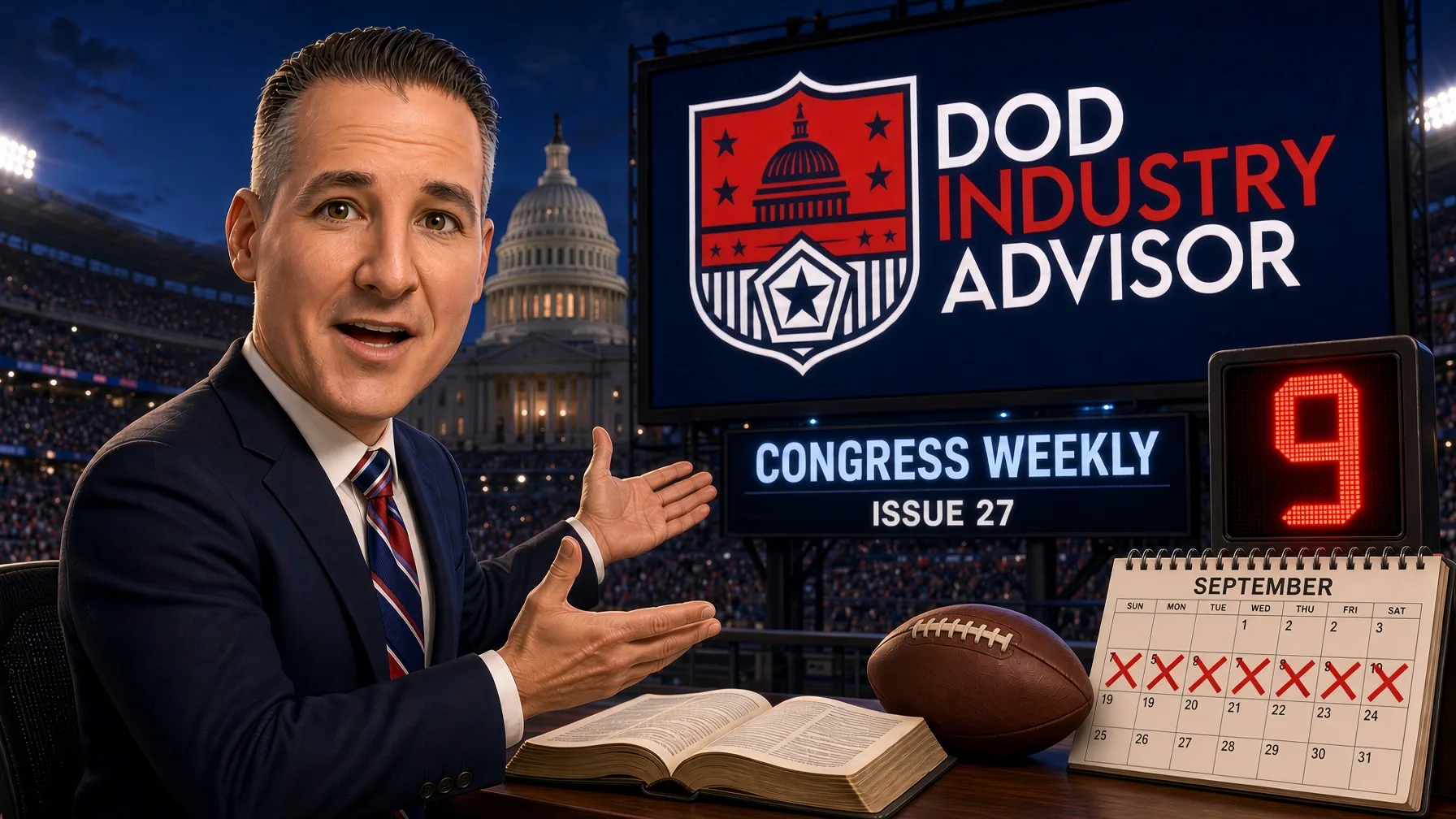
This issue said the House had nine session days left, September 22 through October 2. It had none. House leadership cancelled the September 21 and September 28 session weeks on September 3, the House cast its last votes on September 16, and its next votes are set for November 9. The published calendar we relied on listed eight days, not nine. The Senate also did not meet on September 21. Those errors are in the Mission Brief, the Congressional Calendar section, the calendar grid and the Nine-Day Window section below, which we have left as published so the record is visible.
We have corrected three smaller errors in place: the House vote on H.R. 6500 came two weeks before H. Con. Res. 93, not three; September 14 was the Senate’s first week back, not Congress’s (the House returned August 31); and Drew Lock’s September 20 start was his first of the season. The issue’s core point is unchanged: P.L. 119-103 and Sections 102 and 104 govern through December 11. Issue #28 carries the full correction.
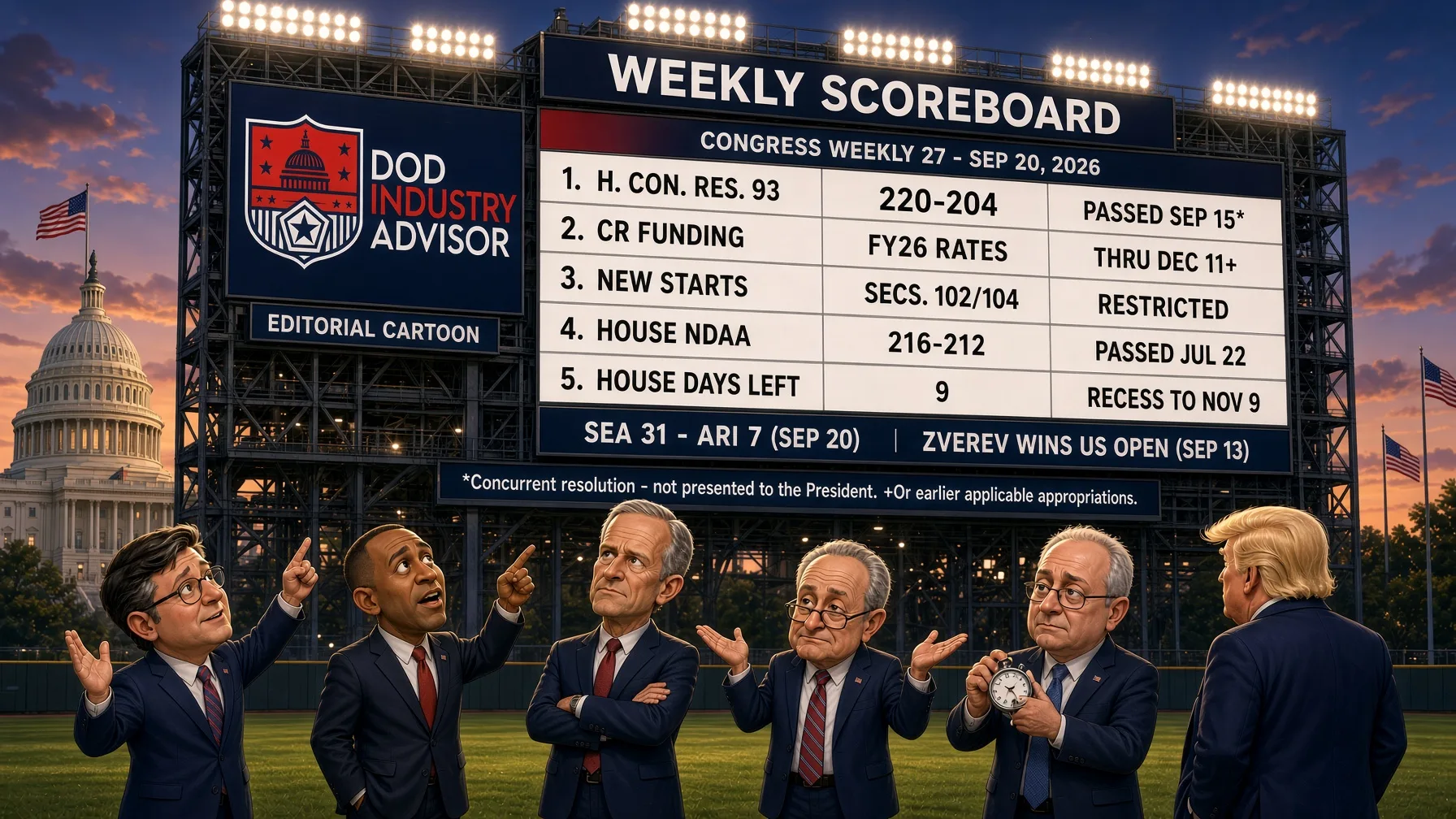
Both chambers were in session this week. The biggest defense-adjacent vote it took was H. Con. Res. 93, passed 220–204 on Tuesday night — a resolution directing the President to remove U.S. forces from hostilities with Iran. Seven Republicans crossed, the largest crossover yet on that question.
It is also a concurrent resolution. By design, a concurrent resolution is not presented to the President. It expresses the will of a chamber. It does not become law, and it does not move a dollar.
That is this week in one object. The chamber produced speech. Your new start still needs cash. And the calendar is now shorter than the freeze: after Friday the House has nine session days — September 22–25, 28–30, and October 1–2 — and then goes dark until November 9. That is five weeks off, with fiscal year 2027 starting October 1 and Public Law 119-103 holding FY26 rates through December 11.
Sections 102 and 104 did not move while the gavels were down, and they will not move while the members are home.
Sunday in Glendale, the scoreboard was not subtle. Seattle 31, Arizona 7. Drew Lock, in his first start for the injured Sam Darnold, threw for 235 yards and three touchdowns — all three to Jaxon Smith-Njigba, who finished with nine catches for 155 yards. The Seahawks closed on a 24-point run, went to 2–0, and took their tenth straight from the Cardinals.
A week earlier at Arthur Ashe, Alexander Zverev beat Ben Shelton 6–3, 7–6(2), 5–7, 6–2 for the U.S. Open title, his second major of the year. Last week's edition left that final unnamed because it had not been played. It has been played. That is how a result works.
Now the Washington version. Tuesday at 10:32 p.m., the House agreed to H. Con. Res. 93, 220–204. Republicans split 7–203; Democrats went 213–0. It was the third time this Congress the House has passed an Iran war powers resolution — the June version cleared 215–208 with four Republicans.
Seven is more than four. The margin grew. The measure passed. And then it went to the Senate, and no further, because that is the whole architecture of a concurrent resolution.
The Seahawks put 31 on the board and it counted. The House put 220 on the board and it expressed a view. Both are real. Only one of them changes what a comptroller will certify in October.
Congressional Calendar — Nine Days, Then the Lights Go Out
Both chambers were in for business September 14–17; the Senate held Friday the 18th alone. This coming week the Senate is in Monday, and both chambers are in Tuesday through Friday.
Then the arithmetic that should be on your capture board: September 22–25, September 28–30, October 1–2. Nine House session days. After October 2 the House is in district work until November 9 — a five-week gap. Fiscal year 2027 begins in the middle of it.
The October 1 cliff was already defused on September 2, so this is not a shutdown countdown. It is something less dramatic and more relevant to your forecast: the number of days available to move full-year appropriations or an authorization before the calendar itself becomes the obstacle. Nine.
| Sun | Mon | Tue | Wed | Thu | Fri | Sat |
|---|---|---|---|---|---|---|
| Sep 13 | 14Both | 15Both · H.Con.Res.93 | 16Both | 17Both | 18Senate | 19 |
| 20today | 21Senate | 22Both | 23Both | 24Both | 25Both | 26 |
| 27 | 28Both | 29Both | 30Both | Oct 1Both · FY27 | 2Both | 3 |
| 4 | 5Recess | 6 | 7 | 8 | 9 | 10 |
| 11 | 12House out to Nov 9 | 13 | 14 | 15 | 16 | 17 |
Dark = both chambers. Outlined = one chamber only. Blank = out. Senate dates from senate.gov; House dates from the Scalise 2026 calendar (March revision) — confirm at majorityleader.gov before you schedule around them.
The Standings — What Belongs on the Board
One column is law. One column is a vote. One column is a scoreboard. Only one of the three moves money.
| Item | What the record establishes | What to watch next |
|---|---|---|
| H. Con. Res. 93 | Passed the House 220–204 on September 15 (R 7–203, D 213–0). A concurrent resolution is not presented to the President. | Whether the Senate takes it up, and whether any binding vehicle follows |
| Continuing resolution | P.L. 119-103 holds FY26 rates through December 11 (Sec. 106(3)). | Full-year bills, and any anomaly that names your specific activity |
| Sections 102 and 104 | No new production, no rate increases above FY26, no new P-1 or R-1 lines, no MYP starts on CR money. | Whether your October action is a continuation or a new start |
| Session calendar | Nine House session days remain before a recess that runs to November 9. | What actually gets floor time in those nine days |
| FY27 NDAA | H.R. 8800 passed the House 216–212 on July 22; Senate cloture on S. 4784 failed 50–46 on July 14. No conference named. | A formal conference step, or Senate floor time inside the nine days |
| DIU Bridge / Nooks | A four-year CIaaS award with a $146.8M ceiling; the FCL-before-buy solicitation was still pending as of the announcement. | The solicitation itself — and a PIID, not a press release |

Speech Is Not Cash — and This Week Proved It Twice
There is a reason to spend a paragraph on parliamentary mechanics in a newsletter for defense small businesses: the mechanics are the lesson.
A concurrent resolution — the “H. Con. Res.” in H. Con. Res. 93 — is agreed to by both chambers and is never presented to the President. It carries no force of law. A joint resolution goes to the President and, signed, becomes law. That is the difference between the vote the House took on Tuesday and the vote it took on H.R. 6500 two weeks earlier. One expressed a position 220 members hold. The other became Public Law 119-103.
Two votes, two weeks apart, in the same chamber. One is a statement. One is your operating environment until December 11.
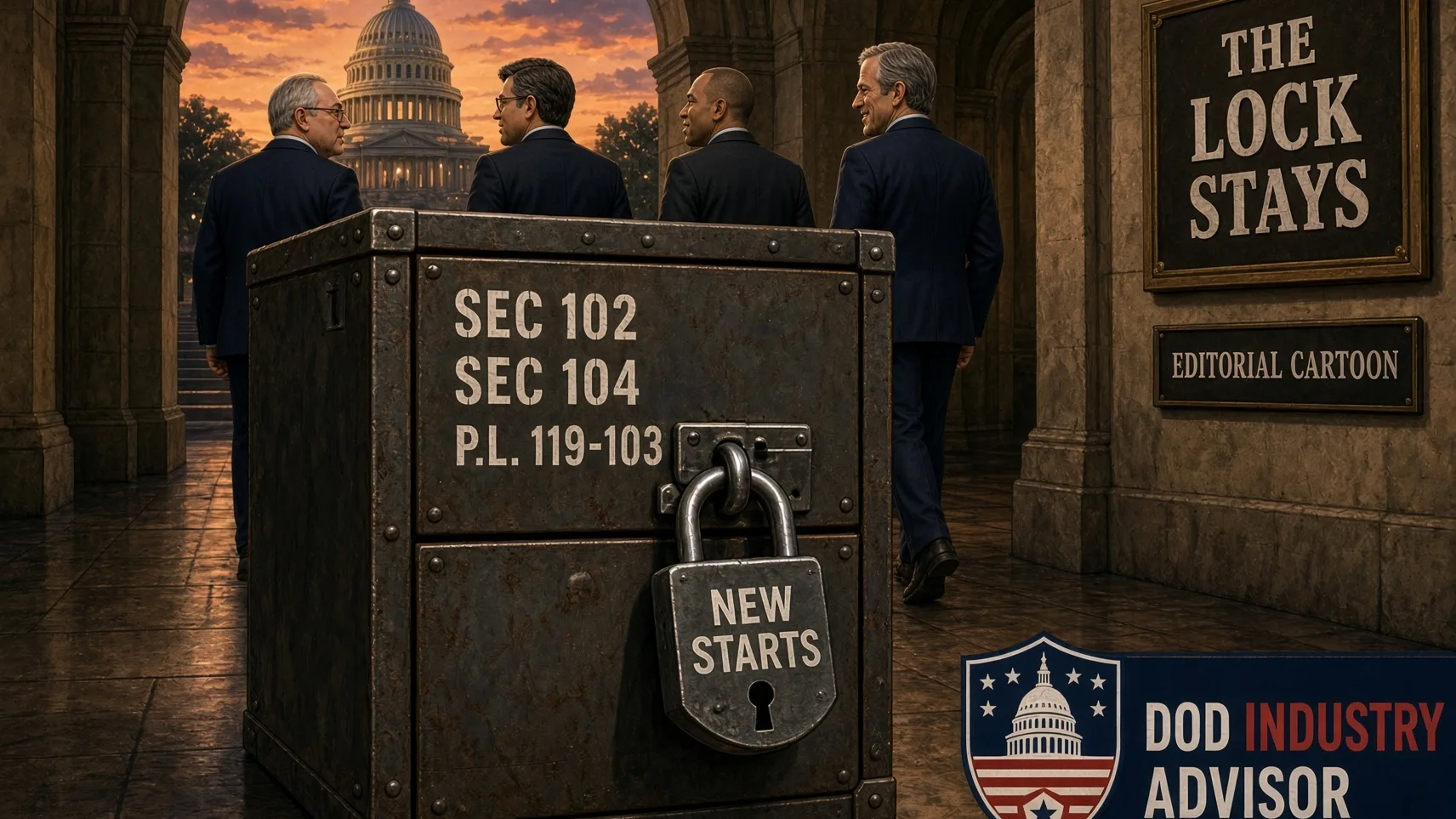
Now read the statute that actually governs your October packet. Section 101 continues covered activities at FY26 rates and conditions. Section 102(a) tells the Department it may not use that money for new production of items not funded in FY26 or prior years, for production-rate increases above FY26 levels, or to initiate projects, activities, P-1 lines or R-1 lines that lacked FY26 authority. Section 102(b) blocks multiyear procurements leaning on advance-procurement or economic-order-quantity money absent a later specific appropriation — narrower than a ban on all multiyear contracts, and worth reading precisely rather than repeating as a slogan. Section 104 extends the same no-initiate rule government-wide. Section 106(3) sets December 11 as the end date, subject to earlier enactment of the applicable appropriations.
None of that softened because the members came back. None of it softens because they leave again on October 2. A recess is not a repeal.
The Nine-Day Window — Read the Card, Not the Chyron
Here is the practical shape of the fall. Nine House session days between now and October 2. Then five weeks in the districts. Then a return on November 9 with roughly a month before the CR lapses on December 11.
What that means for a capture plan is narrower than the cable framing. If your October forecast assumed a full-year defense appropriation, ask what floor time it could plausibly get inside nine days that are already carrying other business. If it assumed an enacted NDAA, note that the House-passed text is from July, Senate cloture failed in July, and no conference has been named. Neither of those is a prediction that nothing happens. Both are reasons to build the packet against what exists rather than what is expected.
Use triggers you can actually observe: a bill text, a committee action, a named conference, an enacted appropriation, or an authorized contract action carrying an identifier. “Congress is back” was last week’s trigger, and it produced a concurrent resolution.
Weekly Digest — A Ceiling Is Still Not Cash
Carrying forward the access story, because it is the one place real money may be moving toward small companies this quarter.
DIU’s Bridge program is built around a chicken-and-egg problem: a company needs a contract or a sponsored DD-254 to begin a facility clearance, but needs clearance to hear the classified requirement in the first place. The announced direction is to let selected nontraditional companies earn a DIU-held facility clearance before the Department buys the product. Alongside it, Nooks announced a four-year classified-infrastructure award with a $146.8 million ceiling and new workspace capacity across six markets.
Say the quiet part plainly. A ceiling is the maximum the government may order. It is not an obligation, not a task order, and not revenue. Capture officers who have watched a headline award decay into a task-order drought know the distinction; founders reading the press release often do not. As of this writing the solicitation had not posted, and the initial cohort was described as a selected group, not open enrollment.
If that is your lane, the useful work this week is artifact preparation — roadmap, architecture, a team you can credibly represent as clearable — and watching for the actual solicitation. If you already sell through primes, the useful question is whether their classified collaboration path runs through shared infrastructure or bespoke SCIF capital expense, because that changes who you need to convince.
What it is not is a Section 102 exception. Access plumbing and production authority are different problems with different documents.
Small Business Playbook — Learn to Tell Speech From Cash
This week gave you a clean training set. Three ideas that let you sort any defense headline in about ninety seconds.
1. Ask which instrument you are looking at. A concurrent resolution expresses a position. A joint resolution or a bill, signed, becomes law. An authorization says a program may exist and at what size. An appropriation provides the money. An obligation commits specific dollars to a specific action. A contract ceiling caps what may be ordered. Those are six different things, and headlines routinely collapse all of them into the word “funded.” When someone says a program was funded, ask which of the six they mean.
2. Ask for the PIID. A Procurement Instrument Identifier is the unique number assigned to a federal contract action. It is the difference between a vehicle and a quote. If a prime, a partner or a press release describes work you could perform, ask for the identifier of the contract that work sits on. A real answer gives you a number you can look up. The absence of one is not proof of bad faith — early-stage pursuits genuinely do not have a PIID yet — but it tells you which stage you are in, which is exactly what your forecast needs to reflect.
3. Ask whether your action is a continuation or a new start. Under the CR this is the question that decides whether October is routine or blocked. Consider a hypothetical sensor supplier already delivering against an FY26-funded line. Continuing that delivery is a continuation. Adding a second production lot that never existed in FY26 is a new start under Section 102(a), and enthusiasm from the program office does not change that. The person who can answer is the contracting officer, and the answer is worth having in writing.
Take the last three pieces of defense news someone forwarded you. For each, write one line: speech or cash, and what document would prove it. If you cannot name the document, you have found the question to ask this week.
The Briefcase — One Page Before the Recess
Nine session days is a short runway, and five weeks of quiet is a long time to be wrong about your October assumptions. Build the page now, not in November.
| Question | What belongs in the answer |
|---|---|
| What are we actually delivering? | The concrete scope, production change or service — with the PIID it sits on, or an honest blank |
| Continuation or new start? | One sentence naming the Section 102/104 exposure, confirmed with the contracting officer |
| What is speech, what is cash? | Every assumption sorted into: enacted law, appropriation, obligation, ceiling, or expectation |
| What survives the recess? | The work that proceeds without new floor action — and who owns the next step by October 2 |
If you are already on contract, keep performing. A CR is not a stop-work, and Congress leaving is not a stop-work either. Get the contracting officer to confirm in writing that your October action is a continuation under FY26 rates.
If you are waiting on a first award, a first production lot, or a multiyear that needed an anomaly, do not staff to a date the calendar cannot support. Nine days is the honest number.
If you sell to a program office waiting on the NDAA, rebuild around House-passed text and a Department still operating inside Sections 102 and 104. Failed cloture in July did not heal over the recess, and no conference has been named.
What did your firm count as this week’s win?
A) Congress was in session, so October feels open
B) We finally treated P.L. 119-103 and Sections 102/104 as the operating rules
C) A headline with a big dollar figure attached to a ceiling
D) A first article, rate increase or multiyear we still need an anomaly for
E) We asked for a PIID and got a straight answer
E is the one that compounds. Reply with your letter and the document you are waiting on — best answer runs next week, anonymous if you want it that way.
The Final Whistle
Seattle put 31 on the board and it counted. Zverev lifted a trophy and it counted. The House put 220 on the board and expressed a view that stops at the Senate door.
Nine days, then five weeks of quiet, then a month before the freeze lapses. The scoreboard is not the statute. Ask which one your October is built on.
How I Help Small Defense Businesses
You may be the owner, the business-development lead and the person checking payroll — all before lunch. The challenge is deciding which opportunity deserves the time your team actually has, especially heading into five weeks when Washington goes quiet and the news stops telling you anything useful.
Through DoD Industry Advisor, I help small defense businesses turn market information into a pursuit decision: examining the buyer, the funding signals, the incumbent and the timing; identifying the gaps in your position; and building a practical plan for what to do next. I also help with proposal and briefing materials when the pursuit calls for them. Explore DIA’s services.
Bring one opportunity you are weighing and the decision you need to make. We can scope the work around whether to pursue it, what needs more evidence, and where your effort belongs over the next 90 days.
Request a 30-minute fit call with DoD Industry Advisor. Start with a non-sensitive summary of your business, the opportunity and your deadline. We will determine fit and define a written scope before work begins.
Sources checked
CONFIRMED
- H. Con. Res. 93: Agreed to in the House Sep. 15, 2026, 10:32 p.m., 220–204 — R 7–203, D 213–0 (Roll Call 307). Directs the President under §5(c) of the War Powers Resolution to remove U.S. forces from hostilities with Iran. Verified 2026-09-21. House Clerk, Roll 307 · text
- Prior Iran war powers vote: H. Con. Res. 86 agreed to Jun. 3, 2026, 215–208 — R 4–207, D 211–0 (Roll Call 199). Verified 2026-09-21. House Clerk, Roll 199
- Concurrent resolutions are not presented to the President and carry no force of law — the distinction from a joint resolution or bill. Structural, not a claim about this vote's prospects.
- P.L. 119-103 (H.R. 6500): Signed Sep. 2, 2026; FY26 rates through Dec. 11, 2026. Sec. 101 rate continuation; Sec. 102(a) new-production / rate / P-1–R-1 bars; Sec. 102(b) MYP-via-advance-procurement/EOQ bar; Sec. 104 general no-initiate rule; Sec. 106(3) end date. Verified 2026-09-13, re-checked 2026-09-21. enrolled text
- FY27 NDAA: H.R. 8800 passed the House 216–212 Jul. 22, 2026; S. 4784 cloture failed 50–46 Jul. 14, 2026 (motion to reconsider keeps it alive); no conference named. Verified 2026-09-21. congress.gov · CRS IN12704
- Session calendar: Both chambers in Sep. 14–17; Senate alone Sep. 18 and Sep. 21; both Sep. 22–25, Sep. 28–30, Oct. 1–2. House then in district work, next votes Nov. 9 — nine House session days, five weeks out. Scalise 2026 House Calendar (March revision) + senate.gov. Verified 2026-09-21.
- NFL Week 2: Seahawks 31, Cardinals 7, Sep. 20, 2026. Drew Lock 235 yds, 3 TD, all to Jaxon Smith-Njigba (9 rec, 155 yds). Seattle 2–0; tenth straight over Arizona. Verified 2026-09-21. ESPN
- U.S. Open men's final: Alexander Zverev d. Ben Shelton 6–3, 7–6(2), 5–7, 6–2, Sep. 13, 2026 — his second major of 2026. Closes the UNKNOWN carried in last week's draft. Verified 2026-09-21. usopen.org
ASSESSMENT
- Nine session days is a genuine constraint on full-year appropriations and NDAA floor time, not a prediction that nothing moves. Floor schedules can change.
- DIU Bridge FCL-before-buy and the Nooks $146.8M CIaaS ceiling remain a supporting industrial beat, not a Section 102 exception. Ceiling ≠ obligation ≠ cash.
UNKNOWN — not found, not invented
- House floor business for the week of Sep. 21: docs.house.gov returned “No schedule is available” at the time of writing for both Sep. 21 and Sep. 22. Not characterized here.
- Defense appropriations floor or markup action during Sep. 14–18: not located. HASC / HAC-D / SAC-D activity for the coming week: not located.
- Whether the Senate takes up H. Con. Res. 93, and on what timeline.
- Whether the DIU Bridge FCL-before-buy solicitation has posted since announcement.
Source presentation is carried in the article body where applicable. Reported facts and analytic judgment are kept distinct.