
A session date tells you when lawmakers return. It does not tell you whether your purchase can proceed. The continuing resolution supplies the framework; the contract file supplies the answer your forecast needs.
Washington is getting the welcome-back cameras ready. Before your business joins the celebration, check what actually changed for your work.
This week’s useful distinction is simple: a session date tells you when lawmakers return. It does not tell you whether a particular purchase can proceed. The continuing resolution supplies the funding framework; the contract file supplies the answer your forecast needs.
The sports pages have results. Your Monday meeting should have evidence.
Elena Rybakina finished the U.S. Open final with a trophy after beating Aryna Sabalenka 6–4, 5–7, 6–2. Seattle finished its kickoff game with a 13–10 win over New England. Two contests, two results nobody has to explain with a press release.
Now imagine the Washington version of the tennis final. The players jog onto court. The crowd stands. Someone reaches for the champagne.
The umpire points at the unopened rulebook.
That is the trap in treating the return from recess as a business-development milestone. There may be more activity, more announcements and more people answering their phones. Those are useful changes. They still leave the question your operations team has to answer: what can we actually deliver, under which funded authority?
You can enjoy the entrance music. Just give finance something more substantial to work with.
Sources: AP · Seahawks game coverage
Congressional Calendar — The Next Whistle
The Senate’s adjournment notice sets its return for Monday, September 14 at 3 p.m. The House has published its legislative business for the week of September 14. That list is the place to monitor what reaches the floor, rather than assuming every item discussed in Washington has a scheduled vote.
For a small business tracking a program, watch what each event can tell you: a briefing may reveal customer concerns, a markup may change proposed legislation, and a floor vote records chamber action. Follow the next document each produces before changing your pursuit plan.
Sources: Senate floor activity · House floor business
| Sun | Mon | Tue | Wed | Thu | Fri | Sat |
|---|---|---|---|---|---|---|
| Sep 13today | 14Both · Senate 3 p.m. | 15Both | 16Both | 17Both | 18Senate | 19 |
| 20 | 21Senate | 22Both | 23Both | 24Both | 25Both | 26 |
| 27 | 28Both | 29Both | 30Both | Oct 1Both · FY27 | 2Both | 3 |
| 4 | 5Recess | 6 | 7 | 8 | 9 | 10 |
Dark = both chambers. Outlined = one chamber only. Senate dates from senate.gov; House dates from published leadership summaries — confirm at majorityleader.gov before you schedule around them.
The Standings — What Belongs on the Board
Read the dates and qualifications alongside each status. A record of what happened is not a forecast of what you can sell.
| Item | What the record establishes | What to watch next |
|---|---|---|
| Continuing resolution | H.R. 6500 became P.L. 119-103 on September 2. | Later appropriations and provisions affecting the specific activity |
| House agenda | The week-of list identifies possible floor business. | Added items, rules and actual action |
| House NDAA | H.R. 8800 passed the House in July. | Current Senate action and any formal next step |
| DIU Bridge | DIU describes support for portfolio-company transition barriers. | Eligibility and usable access for a particular company |
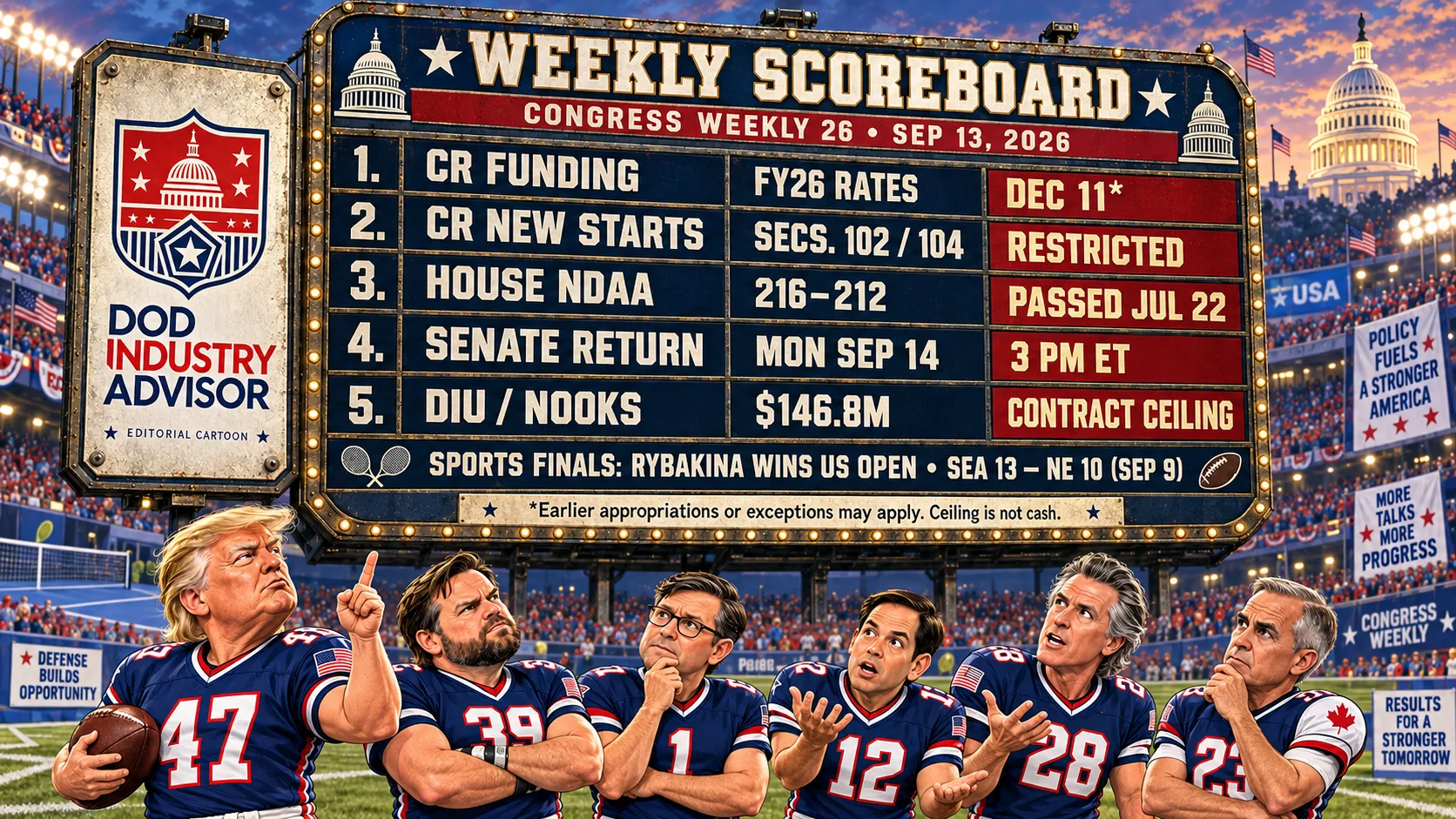
Sources: NARA, House floor list, House bill history, DIU Bridge.
For a small team, this board helps separate developments worth monitoring from decisions that need work today. Pick the row closest to your customer and identify the next evidence you need. That keeps a busy news week from becoming five unrelated pursuits.

The Rulebook — What the CR Means for Your Business
Under the CR, Section 101 generally continues covered activities at FY26 rates and conditions. Sections 102 and 104 constrain specified new activity funded through that provision, including certain production increases. Section 102(b)’s multiyear restriction is narrower than a ban on all multiyear contracts. Section 106 makes December 11 one endpoint, subject to earlier applicable appropriations and the Act’s qualifications. Enrolled text, Sections 101–106
For readers, the important wording is the activity and its funding. A first contract for your company is not, by itself, proof that the government is starting a prohibited new program. Conversely, a familiar customer is not proof that every proposed expansion is covered.
A blanket “we’re fine” or “everything is frozen” is a poor substitute for examining the proposed action.
Give the contracting team the actual scope, funding source and timing. Ask what supports proceeding and what still needs to change.
A short, documented answer is more useful than another optimistic slide.
The Floor List — Read the Card, Not the Hype
The House’s published agenda includes water resources, tax measures, postal designations and other suspension business, alongside items that may move through other procedures. It also includes possible War Powers consideration concerning Iran. The list is broader than a defense-funding story. House business for September 14
A missing defense conference vehicle on that page is a limited observation about the posted schedule. It does not establish what negotiators are doing off the floor. Keep that distinction in your business forecast.
For your watch list, use concrete triggers: a bill text, a committee action, a formal conference step, an appropriation, or an authorized contract action. That gives the next edition a real update to report instead of another welcome-back paragraph.
Weekly Digest — Getting Into the Building
There is a second story worth keeping this week because it concerns a different obstacle: access to classified work.
Nooks announced a four-year DIU contract with a $146.8 million ceiling and described new classified-workspace capacity in six markets. That is the company’s announcement, not a statement that the entire ceiling has been obligated or received. Nooks announcement
DIU’s Bridge page identifies security clearances, classified spaces, technology accreditation and testing among the barriers it seeks to address. It describes current services as supporting DIU portfolio companies, while noting an intent to expand solutions across the department. DIU Bridge
For a company that belongs in that channel, the interesting question is practical: which obstacle could shared infrastructure remove, and when could the company actually use it?
A badge, a room and an approved system can matter enormously. They deserve their own reporting. Bundling them into a general claim that defense spending is suddenly open obscures the progress that may genuinely be happening.
Put the access question beside the funding question in your plan. Give each its own owner and evidence.

Small Business Playbook — Know Which Play You Are Running
A small company cannot afford to send its entire team after every ball. Before you commit proposal time, learn what kind of opportunity is actually in front of you.
1. An RFI is a chance to inform the buyer. A request for information helps the government understand capabilities, pricing or delivery options while planning. Your response is information, not an offer the government can accept to create a contract. Use it to answer the stated questions with evidence: relevant work, achievable delivery and the assumptions behind your answer. Save the generic company history for another day. Acquisition.gov guidance on early industry exchanges
2. Decide who your customer would be. As a prime contractor, you contract directly with the government. As a subcontractor, you work for another contractor. Those are different sales conversations. For a prime pursuit, identify the agency requirement and acquisition path. For a subcontract pursuit, identify the specific work package you can deliver and the prime’s reason to choose you. SBA points businesses to historical awards and prime-contractor directories to research that path. SBA prime and subcontracting guide
3. Turn your capability into a useful answer. Consider a fictional precision-machining shop. “We do machining” leaves the buyer to make the connection. “We can manufacture this component, to these tolerances, with this inspection evidence and this delivery schedule” starts a concrete conversation. Use only claims your team can substantiate. Then ask where that capability fits the customer’s requirement.
That preparation is capture: the work you do to understand the buyer, competition and buying path before deciding how to pursue a contract. Proposal writing is one later part of that effort.
Choose one opportunity and write three sentences — whose problem you solve, what evidence proves you can solve it, and which decision must happen next. If you cannot finish those sentences, you have found your next research task.
The Briefcase — Bring One Page on Monday
Imagine the Monday pipeline meeting. Someone says, “Congress is back.” Another person updates the slide from yellow to green. The delivery lead asks what changed in the file.
That last question is the useful one.
| Question | What belongs in the answer |
|---|---|
| What are we proposing to do? | The concrete delivery, production change or service scope |
| What supports the action? | Identified funding and applicable authority, confirmed with the responsible contracting team |
| What remains unresolved? | A named dependency: funding, authorization, scope, clearance or access |
| Who owns the next step? | One person, one document or decision, and a follow-up date |
If you are performing existing work, focus the conversation on the planned continuation and any proposed changes. If you are expanding, make the additional scope explicit. If classified access is the bottleneck, ask separately about eligibility and the path to usable facilities or systems.
Keep the contract or solicitation identifier with the worksheet when one exists. If it does not exist yet, identify that as a stage in the opportunity rather than filling the space with a headline.
The point is to leave the meeting knowing what happens next — and who is responsible for finding out.
Which obstacle is most likely to delay your next delivery?
A) Funding or contract timing
B) A required authorization or scope decision
C) Clearance, facilities or system access
D) Customer priorities changing
E) We still cannot identify the actual bottleneck
Reply with the letter and the type of decision you are waiting for. We will have a more useful conversation than “Are you optimistic?”
The Final Whistle
The players are back on court. Your move is to find out whether the next point can actually be played.
Bring the file. Let the cameras handle the entrance.
How I Help Small Defense Businesses
You may be the owner, the business-development lead and the person checking payroll — all before lunch. The challenge is deciding which opportunity deserves the time your team actually has.
Through DoD Industry Advisor, I help small defense businesses turn market information into a pursuit decision. That means examining the buyer, funding signals, incumbent and timing; identifying gaps in your position; and building a practical plan for what to do next. I also help with proposal and briefing materials when the pursuit calls for them. Explore DIA’s services.
Bring one opportunity you are weighing and the decision you need to make. We can scope the work around whether to pursue it, what needs more evidence and where your effort belongs over the next 90 days.
Request a 30-minute fit call with DoD Industry Advisor. Start with a non-sensitive summary of your business, the opportunity and your deadline. We will determine fit and define a written scope before work begins.
Sources checked
- U.S. Open women’s final (Sep. 2026): Elena Rybakina d. Aryna Sabalenka 6–4, 5–7, 6–2. Verified 2026-09-13. AP
- NFL Week 1 (Sep. 9, 2026): Seattle 13, New England 10, Lumen Field. Verified 2026-09-13. Seahawks
- Senate schedule: Adjourned to 3:00 p.m. Monday, Sep. 14, 2026. Verified 2026-09-13. senate.gov floor activity
- H.R. 6500 — Continuing Appropriations and Extensions Act, 2027: Became P.L. 119-103 on Sep. 2, 2026; CR runs through Dec. 11, 2026. Verified 2026-09-13. congress.gov actions
- Enrolled text, Secs. 101–106: Sec. 101 continues covered activities at FY26 rates and conditions; Secs. 102 and 104 bar new production and production-rate increases not funded in FY26; Sec. 102(b) restricts multiyear procurement using advance procurement funding for economic order quantity — narrower than a ban on all multiyear contracts; Sec. 106(3) sets Dec. 11, 2026, subject to earlier enactment of applicable appropriations. Verified 2026-09-13. govinfo enrolled text
- FY27 NDAA: H.R. 8800 passed the House 216–212 on Jul. 22, 2026. No enacted NDAA as of publication. Verified 2026-09-13. congress.gov
- House floor business, week of Sep. 14, 2026: Water resources (H.R. 9497), tax measures, postal designations and suspension business; H. Con. Res. 93 (Iran War Powers) added Sep. 11. No defense authorization conference vehicle on the posted schedule. Verified 2026-09-13. docs.house.gov
- Nooks / DIU Bridge: Four-year award, $146.8M ceiling, new sites in six markets (Austin, Boston, Chicago, New York, SF Bay Area, Honolulu). A ceiling is not an obligation. Verified 2026-09-13. PR Newswire · diu.mil
- Small-business guidance: Acquisition.gov, early industry exchanges · SBA prime and subcontracting
- Artwork: All four images are approved editorial illustrations, not documentary photographs. The tennis and football scenes are fictional editorial cartoons.
Source presentation is carried in the article body where applicable. Reported facts and analytic judgment are kept distinct.