
A July 2026 Congress Weekly on the four clocks controlling small-defense capture: House floor time, appropriations, Pentagon reprogramming, and Space Force acquisition hiring.

Congress reached the July break with the defense calendar split in two: the House floor kept seizing over the SAVE Act and the National Defense Authorization Act, while Senate appropriators were already talking about a continuing resolution before the September 30 funding deadline. At the Pentagon, a $4.3 billion omnibus reprogramming request tried to move money toward personnel and operations by stripping selected weapons, R&D, and procurement lines. In space, Space Systems Command said it wants to hire 100 civilians a month, with contracting and cyber near the front of the line. For small defense businesses, the week was not about one clean bill. It was about clocks: floor time, funding time, reprogramming time, and the hiring clock inside the offices that actually turn requirements into awards.
Philadelphia is getting ready for the All-Star Game, which is useful because Washington spent the week looking like a roster with too many closers and nobody willing to take the mound. The House could not keep the floor open. Senate appropriators were already gaming out a continuing resolution. The Pentagon, meanwhile, was not waiting for a clean inning: it sent Congress a reprogramming request that would move current-year money out of selected program lines and into personnel and operational pressure points.
That is the tell. When the box score is messy, watch the substitution pattern. Money leaves one line. People get hired in another office. A committee delays a markup. A rule vote collapses. None of those is the award notice you are waiting for, but all of them change the timing of the award notice you are waiting for.
The Midseason Roster Check
The week was less about wins and losses than bullpen management.
| Roster Spot | Status | Signal |
|---|---|---|
| House NDAA Floor Time | Repeated rule fights over the SAVE Act keep crowding out planned business. | ▼ Timing risk |
| Senate Appropriations | Members are already discussing a short-term CR before the September deadline. | — Watch cash flow |
| Pentagon Reprogramming | $4.3B request moves current-year funds toward personnel and operations. | ▼ Program-line churn |
| Space Systems Command | Hiring push targets acquisition capacity, especially contracting and cyber. | ▲ Early capture window |
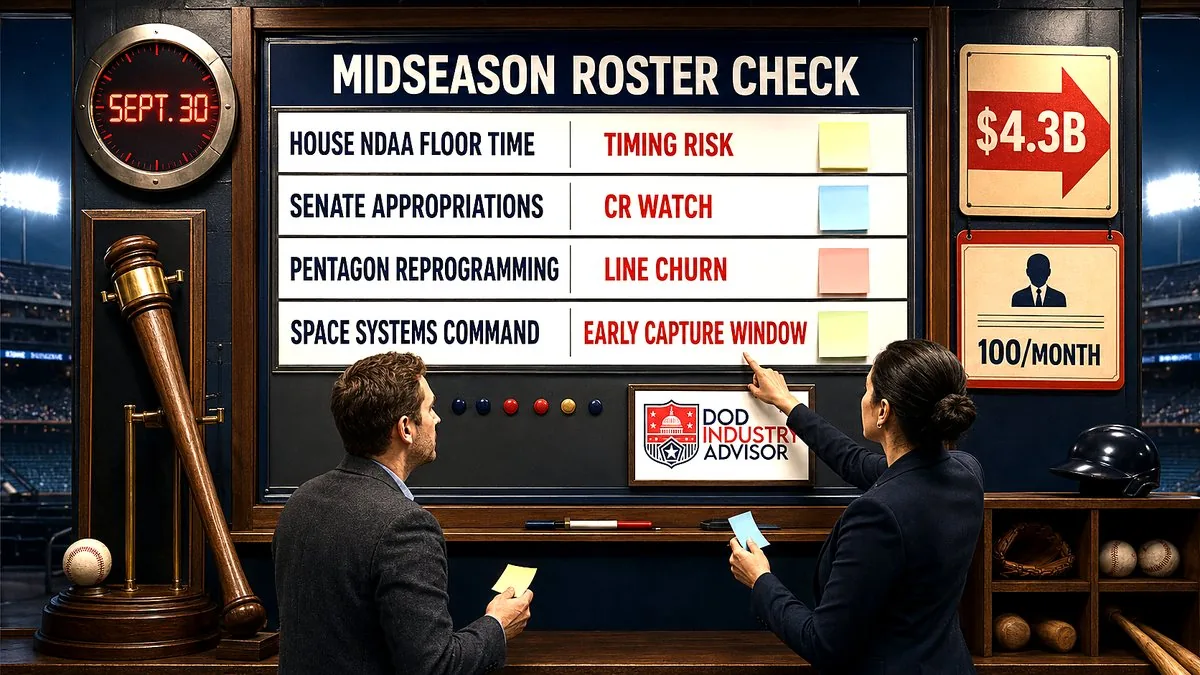
The Floor Jam Is Now a Capture Variable
Axios reported on July 10 that Speaker Mike Johnson was heading into another week with the same floor problem: a bloc of House Republicans willing to shut down procedural rule votes over the SAVE Act. The outlet reported that Johnson had just presided over the ninth failed rule vote of his speakership, with 13 members tanking the prior week’s rule vote, and that the National Defense Authorization Act was one of the pieces of business caught in the fight.
For contractors, this is not inside baseball. A failed rule is not just a bad day for leadership; it is lost legislative bandwidth. When the floor cannot clear the procedural runway, defense authorizations, amendments, and signaling votes do not merely slow down. They become hostage to unrelated leverage.
Small businesses do not need a perfect forecast. They need to know when Congress has stopped giving the market clean timing signals.
The practical effect is a summer of weaker assumptions. If your pipeline depends on a defense policy provision, a new authority, a set-aside nudge, a reporting requirement, or a program direction that still needs floor action, treat the date as soft. Build the plan around what can move without Congress first: agency-level engagement, incumbent teaming, unfunded requirements, reprogramming notices, and the offices that can still shape acquisition strategy while the House sorts out its rules problem.
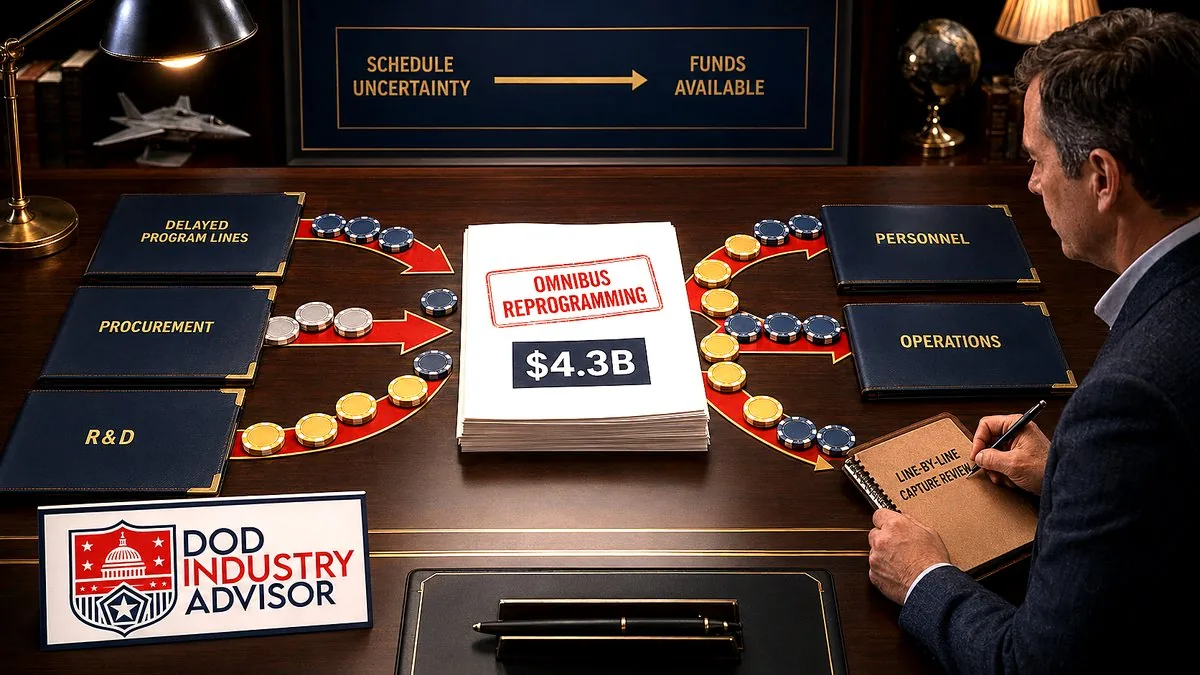
The Pentagon Moved the Money Before the Fall Fight
Breaking Defense reported July 9 that the Pentagon sent lawmakers a 47-page omnibus reprogramming request dated June 29, seeking to reroute roughly $4.3 billion from fiscal 2026 accounts toward higher-priority items, including personnel and operational costs. The request would add personnel money across the Army, Army National Guard, Navy, Marine Corps, Air Force, and Space Force, while pulling from selected weapon, procurement, R&D, construction, and recapitalization lines.
The important contractor lesson is not that every reduced line is dead. Reprogramming is not cancellation. But it is a public stress test. The department is saying, in writing, which accounts have enough schedule uncertainty, under-execution, delay, or flexibility to be raided for immediate needs. That is intelligence. Not dramatic intelligence. Useful intelligence.
Breaking Defense identified examples across the services: Army missile procurement reductions, Navy aircraft procurement and R&D cuts, a large hit to the T-AGOS SURTASS ships line, money pulled from CVN-81 due to program delays, Air Force aircraft procurement reductions including F-35 money, and Space Force reductions in R&D and space procurement. If you sell into one of those lanes, the Monday move is not panic. It is a line-by-line capture review: what moved, why it moved, whether the reason was delay, under-execution, reprioritization, or true loss of demand, and whether your target buyer still has a path to obligation this fiscal year.
Space Force Is Hiring the People Who Make Awards Real
Space Systems Command’s hiring push is the cleaner signal hiding inside the week’s mess. Federal News Network reported July 9 that SSC plans to hire 100 civilians a month as it rebuilds after 2025 workforce cuts, with contracting and cybersecurity among the top priorities. The official SSC Q&A with Executive Director Natalie Riedel says the command is in a rebuilding year, has more than 1,000 resumes from hiring events, and is trying to fill critical vacancies so it can execute the mission and the budget ahead.
That matters because acquisition does not happen in the abstract. It happens through people: program managers, contracting officers, cyber reviewers, financial managers, engineers, security staff, logisticians, and lawyers. Riedel, a former SSC director of contracting and Space Force head of contracting activity, called contracting foundational to acquisition. She also described contracting as the most understaffed function, hovering around 60 percent and trying to move closer to 80 percent.
For a small business, that is a map. If the customer is rebuilding contracting and cyber, bring the acquisition path and cyber boundary to the conversation before they ask. Do not hand a short-staffed office a generic capability deck and make them invent the buy. Show the vehicle, funding color, data-rights posture, integration point, test plan, and risk owner. Help the new bench move the ball.
What This Means for You
• Separate policy timing from money timing: If a capture depends on the NDAA, mark it as politically exposed. If it depends on current-year execution, check reprogramming risk first.
• Read reprogramming notices like market research: A cut tied to delay means something different from a cut tied to lower demand. The first may be a timing problem; the second may be a market problem.
• Track acquisition headcount: Hiring in contracting, cyber, program management, and finance is an early signal that an office may regain the capacity to move solicitations.
• Build a CR scenario now: If senators are already talking about a short-term continuing resolution in July, your fall cash-flow plan should not assume a smooth September finish.
Pick your top three pursuits and assign each one a clock: floor clock, funding clock, reprogramming clock, or workforce clock. If you cannot name which clock controls the opportunity, you do not yet have a capture plan. You have a wish list.

The Reader’s Box
Which clock is actually controlling your best opportunity right now: Congress, appropriations, reprogramming, or the customer's acquisition workforce?
Sources Checked
• Axios, July 10, 2026: shutdown-risk reporting, House floor paralysis, failed rule vote context, and appropriations/CR concerns.
• Breaking Defense, July 9, 2026: Pentagon $4.3 billion omnibus reprogramming request and service-level line movements.
• Federal News Network, July 9, 2026, and Space Systems Command, July 8, 2026: SSC hiring push, 100-per-month goal, contracting/cyber priorities, and Riedel’s acquisition workforce comments.
Source presentation is carried in the article body where applicable. Reported facts and analytic judgment are kept distinct.