
Jalen Brunson erased a 16-point Game 5 deficit to end the Knicks’ 53-year drought — on a roster he built with a pay cut. In Washington, Trump signed the $70B Secure America Act into law, the Senate Armed Services Committee advanced the FY27 NDAA, and GAO confirmed small-business contracting fell $3.7B even as total federal procurement hit $793B. The budget got bigger. Small business’s share got smaller. Time to run the comeback.

The Knicks were down sixteen in Game 5 and won the franchise's first title in fifty-three years. Jalen Brunson scored forty-five, took the Finals MVP unanimously, and reminded everyone that he built this roster by handing back $113 million two summers ago so the cap sheet would close. Washington had a closing week of its own. The House passed S. 2, the Secure America Act, on Monday and President Trump signed it Wednesday, putting $70 billion for ICE and Border Patrol into law outside the normal appropriations process. The Senate Armed Services Committee finished its FY27 NDAA markup behind closed doors and advanced the bill 18–9, sending the data-rights and industrial-base fights from last week toward the Senate floor. And the Government Accountability Office confirmed the number every small contractor already felt: federal procurement climbed to $793 billion last year while the small-business share fell $3.7 billion. The game got bigger. Your slice got smaller. This issue is about running the comeback.
There is a particular sound a building makes when a team that has waited fifty-three years finally stops trailing. It is not a roar. It comes a half-second before the roar, when twenty thousand people do the math at the same time and realize the deficit is gone. The Knicks were down sixteen in San Antonio on Saturday night, down ten with under nine minutes left, and Jalen Brunson scored forty-five points — thirteen of them in a row in the fourth quarter — to win Game 5, 94–90, and close out the Spurs 4–1. New York rallied from a double-digit hole in every single one of those four wins. The trophy is going up the Canyon of Heroes on Thursday. The man who delivered it took a $113 million pay cut two years ago so the roster around him could exist.
Washington spent the week proving it can also close, when it wants to and on its own terms. The House passed the Secure America Act on Monday, the President signed it Wednesday, and $70 billion in immigration-enforcement money became law without ever touching a regular appropriations bill. The Senate Armed Services Committee ran its FY27 markup mostly in closed session, then advanced the bill 18–9 and walked it toward the floor. Two closes, two very different rosters.
Here is the frame for the week. Brunson won by sacrificing money up front, grinding back from a deficit, and trusting the people he came up with. Small business in the defense market is staring at a deficit of its own — a record federal budget, a shrinking small-business share, and a procurement system that the industry itself calls the single biggest barrier to getting on the floor. The Knicks just showed the entire country how a comeback is run. The question is whether the small end of the industrial base has the same three things going for it: sacrifice, teaming, and the nerve to keep shooting while you are still behind.
The Garden Scoreboard
Everybody trailed at some point this week. Only one team closed clean.
| Possession | Status | Score |
|---|---|---|
| New York Knicks | Beat San Antonio 4–1; erased a 16-point Game 5 deficit to win the franchise's first championship since 1973; parade Thursday up the Canyon of Heroes | ▲ Champions |
| Secure America Act | House passed S. 2 on June 9; President signed it June 10, putting $70B for ICE and CBP into law via reconciliation | ▲ Now law |
| FY27 NDAA | Senate Armed Services advanced its version 18–9 after a closed markup; HASC had already moved its bill 44–12 the week before | ▲ Out of committee |
| Small-Business Share | GAO: total federal procurement rose to $793B in FY25, but small-business dollars fell roughly $3.7B to $172.6B; SBA has not posted the FY25 scorecard | ▼ Down $3.7B |
| Defense Data Rights | Right-to-repair and technical-data fights from the House markup carry into the Senate bill and toward conference | — Still live |
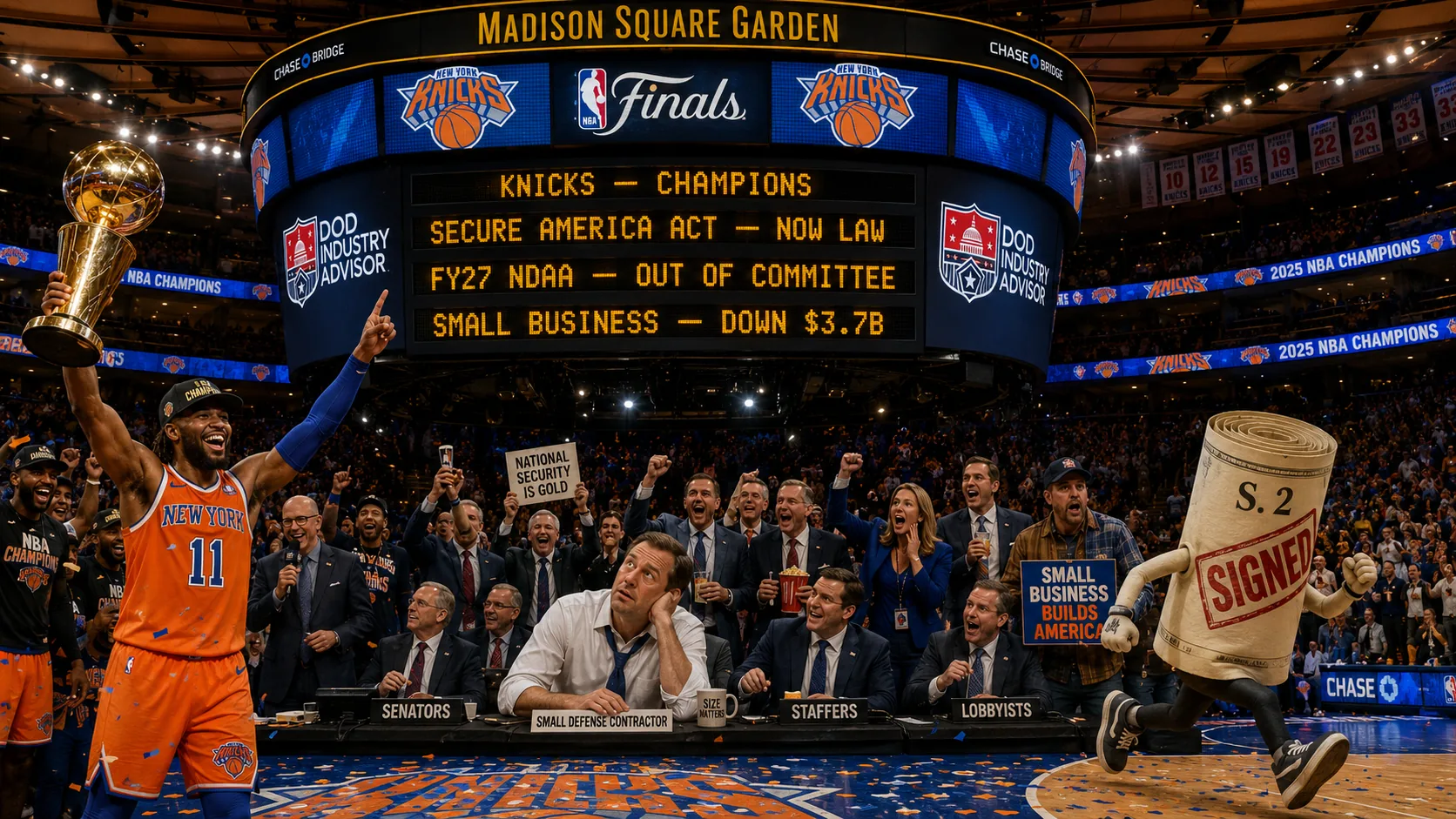
The Comeback Was Built On A Pay Cut
Strip the confetti away and Brunson’s championship is a procurement lesson. In 2024 he signed an extension worth about $113 million less than the maximum he could have demanded, and that gap is the only reason the Knicks could keep OG Anunoby and add Karl-Anthony Towns. He spent money he was owed to buy a roster that could win, then he, Mikal Bridges, and Josh Hart became the first trio of teammates in history to win both an NCAA title and an NBA championship together. Sacrifice up front. Teaming with people you trust. A comeback from behind in all four wins. That is the entire playbook, and it is the same playbook small businesses keep being told to run in the defense market.
“The door is open for small business.” — Rep. Roger Williams, Chairman of the House Small Business Committee, at this month's hearing on the defense industrial base
The trouble is that running this play costs the small firm something real, and the bill comes due before the trophy does. The sacrifice in this league is not salary; it is margin, data rights, and control. To win seed funding through SBIR — reauthorized through 2031 in the law President Trump signed in April, now with Strategic Breakthrough Awards worth up to $30 million — you accept tighter foreign-investment screening and new caps on how many proposals you can file. To team with a prime, you flow down terms that can hand your technical data to the government as a deliverable. The door is open. Walking through it still costs you a pay cut. The firms that win are the ones who decide, before they sign, exactly which money and which rights they are willing to hand back to close the roster.

The Scoreboard Says Small Business Is Losing
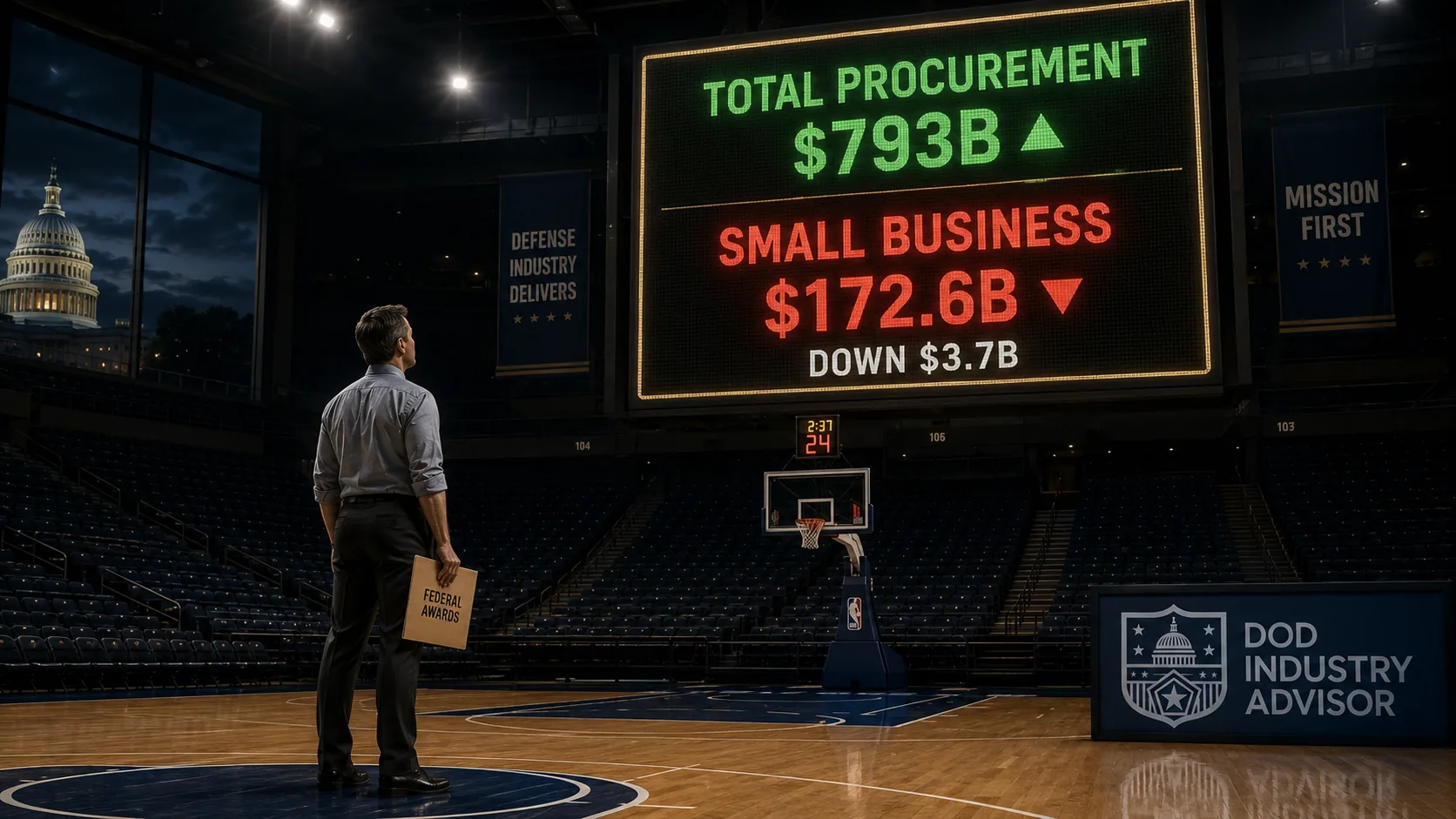
Here is the number that should end every “the door is open” speech until someone explains it. The Government Accountability Office reported that total federal procurement spending rose to $793 billion in FY25, up from $755 billion the year before. Over the same stretch, small-business contracting fell by roughly $3.7 billion, to $172.6 billion. The pie got bigger and the small slice got smaller, in the same year. The SBA has not yet posted its FY25 small-business scorecard; the FY24 version showed about $183.5 billion going to small firms. So the most authoritative recent figure shows the trend pointing down while the topline points up.
There is a fair argument about timing, and an honest newsletter should make it. House Small Business Committee staff note that GAO’s twelve-month window captured some spending under the prior administration, while the committee’s own fifteen-month look covers only the current one — so the two sides are partly measuring different calendars. Fine. Argue the denominator all you want; the direction is still wrong, and the industry has already named the reason. At the committee’s June 3 hearing on the defense industrial base, Chairman Roger Williams said the door is open while Ranking Member Nydia Velázquez countered that “the administration’s actions have made things worse.” The one fact both sides accepted came from the National Defense Industrial Association’s Vital Signs 2026 report: sixty-six percent of industry respondents called complex procurement their single biggest barrier to getting in the game. You cannot complete a comeback if you cannot get on the court.
Pull your own scoreboard before you believe anyone else's. Add up what you actually won in federal awards over the last twelve months versus the twelve before, then put it next to the agencies whose total budgets grew. If your share is flat or down while their topline is up, you are not losing the game on talent — you are losing it on access. Pick the single contract vehicle, set-aside, or teaming relationship that would move that number most, and spend this week on that one thing instead of chasing five.
Last Week The Border Bill Passed The Senate. This Week It’s Law.
Seven days ago this column called the Secure America Act “cleared the Senate” and warned not to book revenue until the House acted. The House acted. Members passed S. 2 on June 9 after clearing the rule on a 213–211 squeaker, and the President signed it into law on June 10. The headline for contractors is the same as before, only firmer: $70 billion for ICE, CBP, detention, surveillance, case management, identity tools, transportation, and facilities now has a statutory home for the next three years. The footnote matters more than the headline. Because this money rode reconciliation rather than a regular appropriations bill, it arrives without the detailed committee reports and explanatory statements that usually tell agencies and vendors what Congress actually intended. The dollars are real. The instruction manual is thin.
On the defense side, the pattern from last week held. House Armed Services moved its FY27 NDAA 44–12 the week before; this week the Senate Armed Services Committee advanced its own version 18–9 after a markup conducted mostly behind closed doors. That means the two chambers now have competing defense bills, and the data-rights and right-to-repair fights we flagged last issue — who owns the technical data, the software, and the repair manual after a contract closes — are no longer a one-committee curiosity. They are heading into a conference where small firms have the least lobbying weight and the most to lose. Money is moving. So are the strings attached to it.
What This Means for You
• Border-tech vendors: the lane is open, the map is not. S. 2 is law, so the ICE and CBP funding is durable for three years — but reconciliation skipped the usual report language. Read the statute itself, watch for implementing guidance and obligation timelines, and do not assume agency intent that Congress never wrote down.
• Defense subs: the data-rights fight just doubled. Both the House and Senate NDAAs are live, and right-to-repair language is heading to conference. Inventory your technical data, software, firmware, models, and manuals now, and know which were privately funded, before a prime writes them into your CDRLs.
• SBIR firms: use the new tools before someone else does. The reauthorization signed in April runs through 2031 and adds Strategic Breakthrough Awards up to $30 million, but it also caps proposal volume and tightens foreign-investment screening starting in FY27. Build your security and data-rights story now so a denial does not catch you flat.
• Everyone: trust the GAO number, not the speech. Procurement hit $793 billion while small-business dollars fell to $172.6 billion. Treat “the door is open” as a prompt to audit your own access, not as evidence that the share is growing. The comeback is on you, not on the topline.
The Reader’s Box
Brunson handed back $113 million to build a roster that could win. What is the one thing — margin, exclusivity, data rights, a favorite line of business, a comfortable prime relationship — you would have to give up to actually grow your federal share next year? Reply with the trade you are not willing to make. Best answer runs next week, anonymous if needed.

Source presentation is carried in the article body where applicable. Reported facts and analytic judgment are kept distinct.